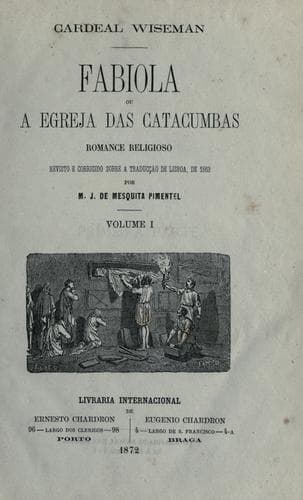
Fabiola; Or, The Church of the CatacombsWiseman, Nicholas Patrick
HistoryHistory
Fabiola; Or, The Church of the Catacombs
Wiseman, Nicholas Patrick
Christian fiction; Church history -- Primitive and early church, ca. 30-600 -- Fiction; Historical fiction
But to her this was an hour of still deeper, or, shall we say, sublimer
feeling. It was a period looked forward to anxiously for years; a moment
prayed for with all the fervor of a mother’s supplication. Many a pious
parent has devoted her infant son from the cradle to the holiest and
noblest state
[Illustration: Ordination in the Early Ages of the Church.]
that earth possesses; has prayed and longed to see him grow up to be,
first a spotless Levite, and then a holy priest at the altar; and has
watched eagerly each growing inclination, and tried gently to bend the
tender thought towards the sanctuary of the Lord of Hosts. And if this
was an only child, as Samuel was to Anna, that dedication of all that is
dear to her keenest affection, may justly be considered as an act of
maternal heroism. What then must be said of ancient matrons,--Felicitas,
Symphorosa, or the unnamed mother of the Maccabees,--who gave up or
offered their children, not one, but many, yea all, to be victims
whole-burnt, rather than priests, to God?
It was some such thought as this which filled the heart of Lucina in
that hour; while, with closed eyes, she raised it high to heaven, and
prayed for strength. She felt as though called to make a generous
sacrifice of what was dearest to her on earth; and though she had long
foreseen it and desired it, it was not without a maternal throe that its
merit could be gained. And what was passing in that boy’s mind, as he
too remained silent and abstracted? Not any thought of a high destiny
awaiting him. No vision of a venerable Basilica, eagerly visited 1600
years later by the sacred antiquary and the devout pilgrim, and giving
his name, which it shall bear, to the neighboring gate of Rome.[11] No
anticipation of a church in his honor to rise in faithful ages on the
banks of the distant Thames, which, even after desecration, should be
loved and eagerly sought as their last resting-place, by hearts faithful
still to his dear Rome.[12] No forethought of a silver canopy or
_ciborium_, weighing 287 lbs., to be placed over the porphyry urn that
should contain his ashes, by Pope Honorius I.[13] No idea that his name
would be enrolled in every martyrology, his picture, crowned with rays,
hung over many altars, as the boy-martyr of the early Church. He was
only the simple-hearted Christian youth, who looked upon it as a matter
of course that he must always obey God’s law and His Gospel; and only
felt happy that he had that day performed his duty, when it came under
circumstances of more than usual trial. There was no pride, no
self-admiration in the reflection; otherwise there would have been no
heroism in his act.
Public-domain text, read in full here on John Shaqi.
Reviews
Reviews
No reviews yet
Be the first to share your thoughts on this work.
Join the Discussion
Join the discussion
Sign in to leave a comment or review.
Sign InorCreate an account