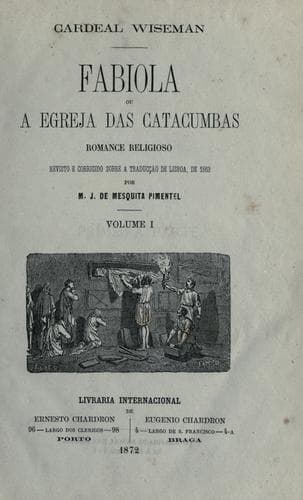
Fabiola; Or, The Church of the CatacombsWiseman, Nicholas Patrick
HistoryHistory
Fabiola; Or, The Church of the Catacombs
Wiseman, Nicholas Patrick
Christian fiction; Church history -- Primitive and early church, ca. 30-600 -- Fiction; Historical fiction
When he raised again his eyes, after his calm reverie of peaceful
thoughts, in the new light which brightly filled the hall, they met his
mother’s countenance gazing anew upon him, radiant with a majesty and
tenderness such as he never recollected to have seen before. It was a
look almost of inspiration; her face was as that of a vision; her eyes
what he would have imagined an angel’s to be. Silently, and almost
unknowingly, he had changed his position, and was kneeling before her;
and well he might; for was she not to him as a guardian spirit, who had
shielded him ever from evil; or might he not well see in her the living
saint whose virtues had been his model from childhood? Lucina broke the
silence, in a tone full of grave emotion.
“The time is at length come, my dear child,” she said, “which has long
been the subject of my earnest prayer, which I have yearned for in the
exuberance of maternal love. Eagerly have I watched in thee the opening
germ of each Christian virtue, and thanked God as it appeared. I have
noted thy docility, thy gentleness, thy diligence, thy piety, and thy
love of God and man. I have seen with joy thy lively faith, and thy
indifference to worldly things, and thy tenderness to the poor. But I
have been waiting with anxiety for the hour which should decisively show
me whether thou wouldst be content with the poor legacy of thy mother’s
weakly virtue, or art the true inheritor of thy martyred father’s
nobler gifts. That hour, thank God, has come to-day!”
“What have I done, then, that should thus have changed or raised thy
opinion of me?” asked Pancratius.
“Listen to me, my son. This day, which was to be the last of thy school
education, methinks that our merciful Lord has been pleased to give thee
a lesson worth it all; and to prove that thou hast put off the things of
a child, and must be treated henceforth as a man; for thou canst think
and speak, yea, and act as one.”
“How dost thou mean, dear mother?”
“What thou hast told me of thy declamation this morning,” she replied,
“proves to me how full thy heart must have been of noble and generous
thoughts; thou art too sincere and honest to have written, and fervently
expressed, that it was a glorious duty to die for the faith, if thou
hadst not believed it and felt it.”
“And truly I do believe and feel it,” interrupted the boy. “What greater
happiness can a Christian desire on earth?”
Public-domain text, read in full here on John Shaqi.
Reviews
Reviews
No reviews yet
Be the first to share your thoughts on this work.
Join the Discussion
Join the discussion
Sign in to leave a comment or review.
Sign InorCreate an account