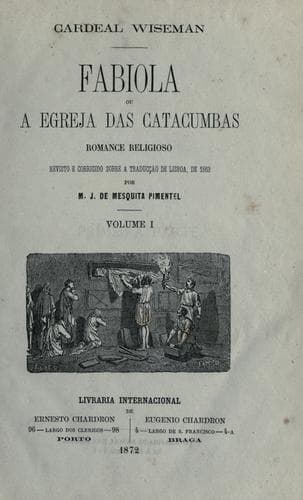
Fabiola; Or, The Church of the CatacombsWiseman, Nicholas Patrick
HistoryHistory
Fabiola; Or, The Church of the Catacombs
Wiseman, Nicholas Patrick
Christian fiction; Church history -- Primitive and early church, ca. 30-600 -- Fiction; Historical fiction
“This, too, is thy father’s blood, Pancratius,” she said, with faltering
voice and streaming eyes. “I gathered it myself from his death-wound,
as, disguised, I stood by his side, and saw him die from the wounds he
had received for Christ.”
She gazed upon it fondly, and kissed it fervently; and her gushing tears
fell on it, and moistened it once more. And thus liquefied again, its
color glowed bright and warm, as if it had only just left the martyr’s
heart.
[Illustration: A piece of a “Gold glass” found in the Catacombs.]
The holy matron put it to her son’s quivering lips, and they were
empurpled with its sanctifying touch. He venerated the sacred relic with
the deepest emotions of a Christian and a son; and felt as if his
father’s spirit had descended into him, and stirred to its depths the
full vessel of his heart, that its waters might be ready freely to flow.
The whole family thus seemed to him once more united. Lucina replaced
her treasure in its shrine, and hung it round the neck of her son,
saying: “When next it is moistened, may it be from a nobler stream than
that which gushes from a weak woman’s eyes!” But heaven thought not so;
and the future combatant was anointed, and the future martyr was
consecrated, by the blood of his father mingled with his mother’s
tears.
CHAPTER IV.
THE HEATHEN HOUSEHOLD.
While the scenes described in the three last chapters were taking place,
a very different one presented itself in another house, situated in the
valley between the Quirinal and Esquiline hills. It was that of Fabius,
a man of the equestrian order, whose family, by farming the revenues of
Asiatic provinces, had amassed immense wealth. His house was larger and
more splendid than the one we have already visited. It contained a third
large peristyle, or court, surrounded by immense apartments; and besides
possessing many treasures of European art, it abounded with the rarest
productions of the East. Carpets from Persia were laid on the ground,
silks from China, many-colored stuffs from Babylon, and gold embroidery
from India and Phrygia covered the furniture; while curious works in
ivory and in metals, scattered about, were attributed to the inhabitants
of islands beyond the Indian ocean, of monstrous form and fabulous
descent.
Public-domain text, read in full here on John Shaqi.
Reviews
Reviews
No reviews yet
Be the first to share your thoughts on this work.
Join the Discussion
Join the discussion
Sign in to leave a comment or review.
Sign InorCreate an account