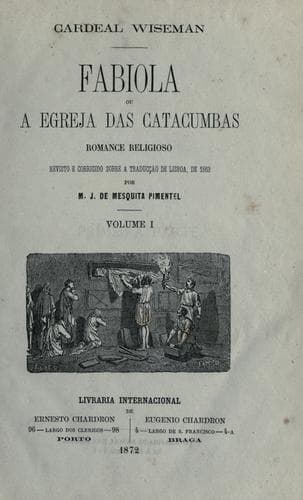
Fabiola; Or, The Church of the CatacombsWiseman, Nicholas Patrick
HistoryHistory
Fabiola; Or, The Church of the Catacombs
Wiseman, Nicholas Patrick
Christian fiction; Church history -- Primitive and early church, ca. 30-600 -- Fiction; Historical fiction
Fulvius did not speak another word; but kissed the emperor’s hand and
slowly retired. He looked a ruined, broken man. He was only heard to
say, as he passed out of the gate: “Then, after all, she _has_ made me a
beggar too.” When he reached home, Eurotas, who read his answer in his
nephew’s eye, was amazed at his calmness.
“I see,” he drily remarked, “it is all over.”
“Yes; are your preparations made, Eurotas?”
“Nearly so. I have sold the jewels, furniture, and slaves, at some loss;
but, with the trifle I had in hand, we have enough to take us safe to
Asia. I have retained Stabio, as the most trusty of our servants; he
will carry our small travelling requisites on his horse. Two others are
preparing for you and me. I have only one thing more to get for our
journey, and then I am ready to start.”
“Pray what is that?”
“The poison. I ordered it last night, but it will only be ready at
noon.”
“What is that for?” asked Fulvius, with some alarm.
“Surely you know,” rejoined the other, unmoved. “I am willing to make
one more trial any where else; but our bargain is clear; my father’s
family must not end in beggary. It must be extinguished in honor.”
Fulvius bit his lip, and said, “Well, be it as you like, I am weary of
life. Leave the house as soon as possible, for fear of Ephraim, and be
with your horses at the third mile on the Latin gate soon after dusk. I
will join you there. For I, too, have an important matter to transact
before I start.”
“And what is that?” asked Eurotas, with a rather keen curiosity.
“I cannot tell even you. But if I am not with you by two hours after
sunset, give me up, and save yourself without me.”
Eurotas fixed upon him his cold dark eye, with one of those looks which
ever read Fulvius through; to see if he could detect any lurking idea of
escape from his gripe. But his look was cool and unusually open, and the
old man asked no more. While this dialogue was going on, Fulvius had
been divesting himself of his court garments, and attiring himself in a
travelling suit. So completely did he evidently prepare himself for his
journey, without necessity of returning home, that he even took his
weapons with him; besides his sword, securing in his girdle, but
concealed under his cloak, one of those curved daggers, of highest
temper and most fatal form, which were only known in the East.
Public-domain text, read in full here on John Shaqi.
Reviews
Reviews
No reviews yet
Be the first to share your thoughts on this work.
Elsewhere in the archive
Join the Discussion
Join the discussion
Sign in to leave a comment or review.
Sign InorCreate an account