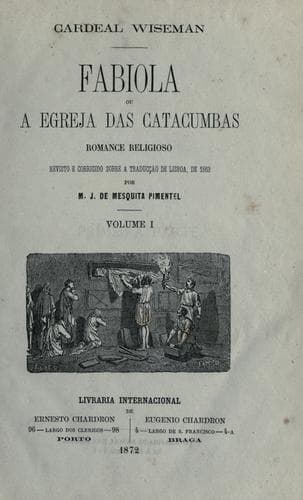
Fabiola; Or, The Church of the CatacombsWiseman, Nicholas Patrick
HistoryHistory
Fabiola; Or, The Church of the Catacombs
Wiseman, Nicholas Patrick
Christian fiction; Church history -- Primitive and early church, ca. 30-600 -- Fiction; Historical fiction
Eurotas proceeded at once to the Numidian quarters in the palace, and
asked for Jubala; who entered with two small flasks of different sizes,
and was just going to give some explanations, when her husband,
half-drunk, half-furious, was seen approaching. Eurotas had just time to
conceal the flasks in his belt, and slip a coin into her hand, when
Hyphax came up. His wife had mentioned to him the offers which Eurotas
had made to her before marriage, and had excited in his hot African
blood a jealousy that amounted to hatred. The savage rudely thrust his
wife out of the apartment, and would have picked a quarrel with the
Syrian; had not the latter, his purpose being accomplished, acted with
forbearance, assured the archer-chief that he should never more see him,
and retired.
It is time, however, that we return to Fabiola. The reader is probably
prepared to hear us say, that she returned home a Christian: and yet it
was not so. For what as yet did she know of Christianity, to be said to
profess it? In Sebastian and Agnes she had indeed willingly admired the
virtue, unselfish, generous, and more than earthly, which now she was
ready to attribute to that faith. She saw that it gave motives of
actions, principles of life, elevation of mind, courage of conscience,
and determination of virtuous will, such as no other system of belief
ever bestowed. And even if, as she now shrewdly suspected, and intended
in calmer moments to ascertain, the sublime revelations of Syra,
concerning an unseen sphere of virtue, and its all-seeing Ruler, came
from the same source, to what did it all amount more than to a grand
moral and intellectual system, partly practical, partly speculative, as
all codes of philosophic teaching were? This was a very different thing
from Christianity. She had as yet heard nothing of its real and
essential doctrines, its fathomless, yet accessible, depths of mystery;
the awful, vast, and heaven-high structure of faith, which the simplest
soul may contain; as a child’s eye will take in the perfect reflection
and counterpart of a mountain, though a giant cannot scale it. She had
never heard of a God, One in Trinity; of the co-equal Son incarnate for
man. She had never been told of the marvellous history, of Redemption by
God’s sufferings and death. She had not heard of Nazareth, or Bethlehem,
or Calvary. How could she call herself a Christian, or be one, in
ignorance of all this?
How many names had to become familiar and sweet to her which as yet were
unknown, or barbarous--Mary, Joseph, Peter, Paul, and John? Not to
mention the sweetest of all, His, whose name is balm to the wounded
heart, or as honey dropping from the broken honeycomb. And how much had
she yet to learn about the provision for salvation on earth, in the
Church, in grace, in sacraments, in prayer, in love, in charity to
others! What unexplored regions lay beyond the small tract which she had
explored!
Public-domain text, read in full here on John Shaqi.
Reviews
Reviews
No reviews yet
Be the first to share your thoughts on this work.
Elsewhere in the archive
Join the Discussion
Join the discussion
Sign in to leave a comment or review.
Sign InorCreate an account