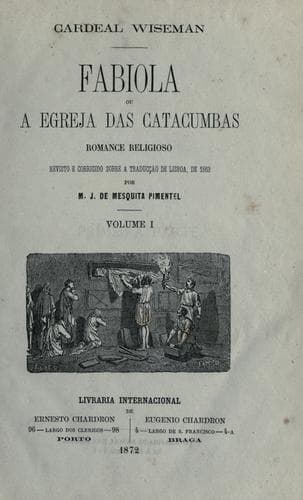
Fabiola; Or, The Church of the CatacombsWiseman, Nicholas Patrick
HistoryHistory
Fabiola; Or, The Church of the Catacombs
Wiseman, Nicholas Patrick
Christian fiction; Church history -- Primitive and early church, ca. 30-600 -- Fiction; Historical fiction
In his blind fury he refused her credit; but the words, in their native
tongue, which said, “Remember my scarf which you picked up here,”
brought back to his memory so terrible a domestic tale, that had the
earth opened a cavern in that moment before his feet, he would have
leaped into it, to bury his remorse and shame.
Strange, too, it proved, that he should not have ever allowed Eurotas to
get possession of that family relic, but should, ever since he regained
it, have kept it apart as a sacred thing; and when all else was being
packed up, should have folded it up and put it in his breast. And now,
in the act of drawing out his eastern dagger, he had plucked this out
too, and both were found upon the floor.
Dionysius, immediately after dressing the wound, and administering
proper restoratives, which brought back consciousness, desired the
patient to be left perfectly quiet, to see as few persons as possible,
so as to prevent excitement, and to go on with the treatment which he
prescribed until midnight. “I will call,” he added, “very early in the
morning, when I must see my patient alone.” He whispered a few words in
her ear, which seemed to do her more good than all his medicines; for
her countenance brightened into an angelic smile.
Fabiola had her placed in her own bed, and, allotting to her attendants
the outward room, reserved to herself exclusively the privilege, as she
deemed it, of nursing the servant, to whom a few months before she could
hardly feel grateful for having tended her in fever. She had informed
the others how the wound had been inflicted, concealing the relationship
between her assailant and her deliverer.
Although herself exhausted and feverish, she would not leave the bedside
of the patient; and when midnight was past, and no more remedies had to
be administered, she sank to rest upon a low couch close to the bed. And
now what were her thoughts, when, in the dim light of a sick room, she
opened her mind and heart to them? They were simple and earnest. She saw
at once the reality and truth of all that her servant had ever spoken to
her. When she last conversed with her, the principles which she heard
with delight, had appeared to her wholly beyond practice, beautiful
theories, which could not be brought to action. When Miriam had
described a sphere of virtue, wherein no approbation or reward of man
was to be expected, but only the approving eye of God, she had admired
the idea, which powerfully seized her generous mind; but she had
rebelled against its becoming the constraining rule of hourly conduct.
Yet, if the stroke under which she cast herself had proved fatal, as it
might easily have done, where would have been her reward? What, then,
could have been her motive but that very theory, as it seemed, of
responsibility to an unseen power?
Public-domain text, read in full here on John Shaqi.
Reviews
Reviews
No reviews yet
Be the first to share your thoughts on this work.
Elsewhere in the archive
Join the Discussion
Join the discussion
Sign in to leave a comment or review.
Sign InorCreate an account