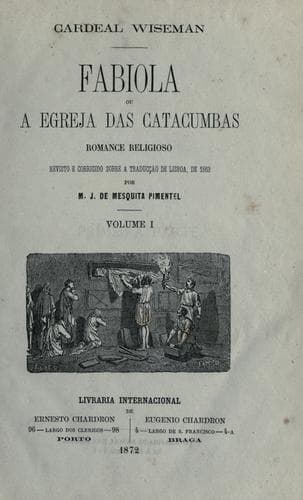
Fabiola; Or, The Church of the CatacombsWiseman, Nicholas Patrick
HistoryHistory
Fabiola; Or, The Church of the Catacombs
Wiseman, Nicholas Patrick
Christian fiction; Church history -- Primitive and early church, ca. 30-600 -- Fiction; Historical fiction
And when Miriam had discoursed of heroism in virtue as being its
ordinary standard, how chimerical the principle had seemed! Yet here,
without preparation, without forethought, without excitement, without
glory,--nay, with marked desire of concealment, this slave had performed
a deed of self-sacrifice, heroic in every way. From what could that
result but from habitual heroism of virtue, ready at any hour to do what
would ennoble forever a soldier’s name? She was no dreamer, then, no
theorist, but a serious, real practiser of all that she taught. Could
this be a philosophy? Oh, no, it must be a religion! the religion of
Agnes and of Sebastian, to whom she considered Miriam every way equal.
How she longed to converse with her again!
Early in the morning, according to his promise, the physician returned,
and found his patient much improved. He desired to be left alone with
her; when, having spread a linen cloth upon the table, and placed
lighted tapers upon it, he drew from his bosom an embroidered scarf, and
uncovered a golden box, the sacred contents of which she well knew.
Approaching her he said:
“My dear child, as I promised you, I have now brought you not merely the
truest remedy of every ailment, bodily and spiritual, but the very
Physician Himself, who by His word alone restoreth all things,[215]
whose touch opens the eyes of the blind and the ears of the deaf, whose
will cleanses lepers, the hem of whose garment sends forth virtue to
cure all. Are you ready to receive Him?”
“With all my heart,” she replied, clasping her hands; “I long to possess
Him whom alone I have loved, in whom I have believed, to whom my heart
belongs.”
“Does no anger or indignation exist in your soul against him who has
injured you? does any pride or vanity arise in your mind at the thought
of what you have done? or are you conscious of any other fault requiring
humble confession and absolution before receiving the sacred gift into
your breast?”
“Full of imperfection and sin I know myself to be, venerable father; but
I am not conscious of any knowing offence. I have had no need to forgive
him to whom you allude; I love him too much for that, and would
willingly give my life to save him. And of what have I to be proud, a
poor servant, who have only obeyed my Lord’s commands?”
“Invite then, my child, this Lord into your house, that coming He may
heal you, and fill you with His grace.”
Approaching the table, he took from it a particle of the Blessed
Eucharist, in the form of unleavened bread, which, being dry, he
moistened in water, and placed within her lips.[216] She closed them
upon it, and remained for some time absorbed in contemplation.
And thus did the holy Dionysius discharge his twofold office of
physician and priest, attributed to him on his tomb.
CHAPTER XXXII.
THE SACRIFICE ACCEPTED.
Public-domain text, read in full here on John Shaqi.
Reviews
Reviews
No reviews yet
Be the first to share your thoughts on this work.
Elsewhere in the archive
Join the Discussion
Join the discussion
Sign in to leave a comment or review.
Sign InorCreate an account