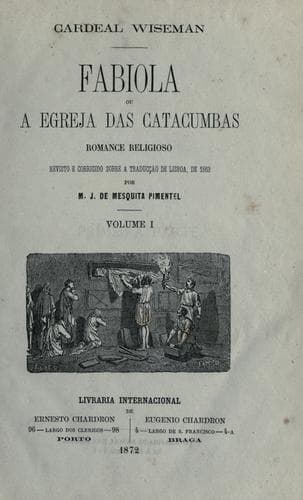
Fabiola; Or, The Church of the CatacombsWiseman, Nicholas Patrick
HistoryHistory
Fabiola; Or, The Church of the Catacombs
Wiseman, Nicholas Patrick
Christian fiction; Church history -- Primitive and early church, ca. 30-600 -- Fiction; Historical fiction
Through the whole of that day the patient seemed occupied with deep, but
most pleasing thoughts. Fabiola, who never left her, except for moments
to give necessary directions, watched her countenance with a mixture of
awe and delight. It appeared as if her servant’s mind were removed from
surrounding objects, and conversing in a totally different sphere. Now a
smile passed like a sunbeam across her features, now a tear trembled in
her eye, or flowed down her cheeks; sometimes her pupils were raised and
kept fixed on heaven for a considerable time, while a blissful look of
perfect and calm enjoyment sat unvarying upon her; and then she would
turn round with an expression of infinite tenderness towards her
mistress, and hold out her hand to be clasped in hers. And Fabiola could
sit thus for hours in silence, which was as yet prescribed; feeling it
an honor, and thinking it did her good, to be in contact with such a
rare type of virtue.
At length, in the course of the day, after giving her patient some
nourishment, she said to her, smiling: “I think you are much better,
Miriam, already. Your physician must have given you some wonderful
medicine.”
“Indeed he has, my dearest mistress.”
Fabiola was evidently pained; and leaning over her, said softly: “Oh, do
not, I entreat you, call me by such a title. If it has to be used, it
should be by me towards you. But, in fact, it is no longer true; for
what I long intended has now been done; and the instrument of your
liberation has been ordered to be made out, not as a freedwoman, but as
an _ingenua_;[217] for such I know you are.”
Miriam looked her thanks, for fear of further hurting Fabiola’s
feelings; and they continued to be happy together in silence.
Towards evening Dionysius returned, and found so great an improvement,
that, ordering more nourishing food, he permitted a little quiet
conversation.
“I must now,” said Fabiola, so soon as they were alone, “fulfill the
first duty, which my heart has been burning to discharge, that of
thanking you,--I wish I knew a stronger word,--not for the life which
you have saved me, but for the magnanimous sacrifice which you made for
it--and, let me add, the unequalled example of heroic virtue, which
alone inspired it.”
“After all, what have I done, but simple duty? You had a right to my
life, for a much less cause than to save yours,” answered Miriam.
“No doubt,” responded Fabiola, “it appears so to you, who have been
trained to the doctrine which overpowered me, that the most heroic acts
ought to be considered by men as performances of ordinary duties.”
“And thereby,” rejoined Miriam, “they cease to be what you have called
them.”
Public-domain text, read in full here on John Shaqi.
Reviews
Reviews
No reviews yet
Be the first to share your thoughts on this work.
Elsewhere in the archive
Join the Discussion
Join the discussion
Sign in to leave a comment or review.
Sign InorCreate an account