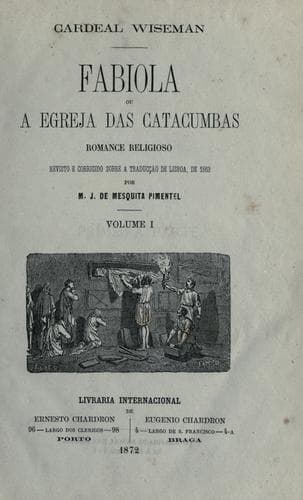
Fabiola; Or, The Church of the CatacombsWiseman, Nicholas Patrick
HistoryHistory
Fabiola; Or, The Church of the Catacombs
Wiseman, Nicholas Patrick
Christian fiction; Church history -- Primitive and early church, ca. 30-600 -- Fiction; Historical fiction
“No, no,” exclaimed Fabiola, with enthusiasm; “do not try to make me
mean and vile to my own heart, by teaching me to undervalue what I
cannot but prize as an unrivalled act of virtue. I have been reflecting
on it, night and day, since I witnessed it; and my heart has been
yearning to speak to you of it, and even yet I dare not, or I should
oppress your weakness with my overcharged feelings. It was noble, it was
grand, it was beyond all reach of praise; though I know you do not want
it. I cannot see any way in which the sublimeness of the act could have
been enhanced, or human virtue rise one step higher.”
Miriam, who was now raised to a reclining position, took Fabiola’s hand
between both hers; and turning round towards her, in a soft and mild,
but most earnest tone, thus addressed her:
“Good and gentle lady, for one moment listen to me. Not to depreciate
what you are good enough to value, since it pains you to hear it, but to
teach you how far we still are from what might have been done, let me
trace for you a parallel scene, but where all shall be reversed. Let it
be a slave--pardon me, dear Fabiola, for another pang--I see it in your
face, but it shall be the last--yes, a slave brutish, ungrateful,
rebellious to the most benign and generous of masters. And let the
stroke, not of an assassin, but of the minister of justice, impend over
his head. What would you call the act, how would you characterize the
virtue, of that master, if out of pure love, and that he might reclaim
that wretched man, he should rush beneath the axe’s blow, ay, and its
preceding ignominious stripes, and leave written in his will, that he
made that slave heir to his titles and his wealth, and desired him to be
considered as his brother?”
“O Miriam, Miriam, you have drawn a picture too sublime to be believed
of man. You have not eclipsed your own deed, for I spoke of _human_
virtue. To act as you have now described would require, if possible,
that of a God!”
Miriam pressed the folded hand to her bosom, fixed on Fabiola’s
wondering eyes a look of heavenly inspiration, as she sweetly and
solemnly replied: “AND JESUS CHRIST, WHO DID ALL THIS FOR MAN, WAS TRULY
GOD.”
Fabiola covered her face with both her hands, and for a long time was
silent. Miriam prayed earnestly in her own tranquil heart.
“Miriam, I thank you from my soul,” at length Fabiola said; “you have
fulfilled your promise of guiding me. For some time I have only been
fearing that you might not be a Christian; but it could not be.
“Now tell me, are those awful, but sweet words, which you just now
uttered, which have sunk into my heart as deeply, as silently, and as
irrevocably as a piece of gold dropped upon the surface of the still
ocean goes down into its depths,--are those words a mere part of the
Christian system, or are they its essential principle?”
Public-domain text, read in full here on John Shaqi.
Reviews
Reviews
No reviews yet
Be the first to share your thoughts on this work.
Elsewhere in the archive
Join the Discussion
Join the discussion
Sign in to leave a comment or review.
Sign InorCreate an account