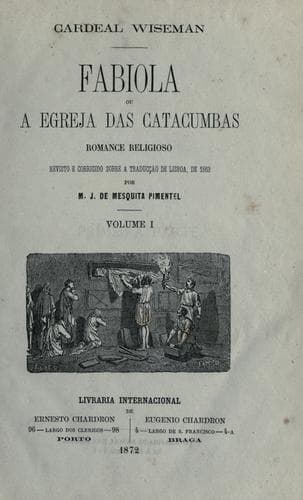
Fabiola; Or, The Church of the CatacombsWiseman, Nicholas Patrick
HistoryHistory
Fabiola; Or, The Church of the Catacombs
Wiseman, Nicholas Patrick
Christian fiction; Church history -- Primitive and early church, ca. 30-600 -- Fiction; Historical fiction
“From a simple allegory, dear lady, your powerful mind has, in one
bound, reached and grasped the master-key of our whole teaching: the
alembic of your fine understanding has extracted, and condensed into one
thought, the most vital and prominent doctrines of Christianity. You
have distilled them into their very essence.
“That man, God’s creature and bondsman, rebelled against his Lord; that
justice irresistible had doomed and pursued him; that this very Lord
‘took the form of a servant, and in habit was found like a man;’[218]
that in this form he suffered stripes, buffets, mockery, and shameful
death, became the ‘Crucified One,’ as men here call Him, and thereby
rescued man from his fate, and gave him part in His own riches and
kingdom: all this is comprised in the words that I have spoken.
“And you had reached the right conclusion. Only God could have
performed so godlike an action, or have offered so sublime an
expiation.”
Fabiola was again wrapped up in silent thought, till she timidly asked:
“And was it to this that you referred in Campania, when you spoke of God
alone being a victim worthy of God?”
“Yes; but I further alluded to the continuation of that sacrifice, even
in our own days, by a marvellous dispensation of an all-powerful love.
However, on this I must not yet speak.”
Fabiola resumed: “I every moment see how all that you have ever spoken
to me coheres and fits together, like the parts of one plant; all
springing one from another. I thought it bore only the lovely flowers of
an elegant theory; you have shown me in your conduct how these can ripen
into sweet and solid fruit. In the doctrine which you have just
explained, I seem to myself to find the noble stem from which all the
others branch forth--even to that very fruit. For who would refuse to do
for another, what is much less than God has done for him? But, Miriam,
there is a deep and unseen root whence springs all this, possibly dark
beyond contemplation, deep beyond reach, complex beyond man’s power to
unravel; yet perhaps simple to a confiding mind. If, in my present
ignorance, I can venture to speak, it should be vast enough to occupy
all nature, rich enough to fill creation with all that is good and
perfect in it, strong enough to bear the growth of your noble tree, till
its summit reach above the stars, and its branches to the ends of earth.
“I mean, your idea of that God, whom you made me fear, when you spoke to
me as a philosopher of Him, and taught me to know as the ever-present
watchman and judge; but whom I am sure you will make me love when, as a
Christian, you exhibit Him to me as the root and origin of such
boundless tenderness and mercy.
“Without some deep mystery in His nature, as yet unknown to me, I cannot
fully apprehend that wonderful doctrine of man’s purchase.”
Public-domain text, read in full here on John Shaqi.
Reviews
Reviews
No reviews yet
Be the first to share your thoughts on this work.
Elsewhere in the archive
Join the Discussion
Join the discussion
Sign in to leave a comment or review.
Sign InorCreate an account