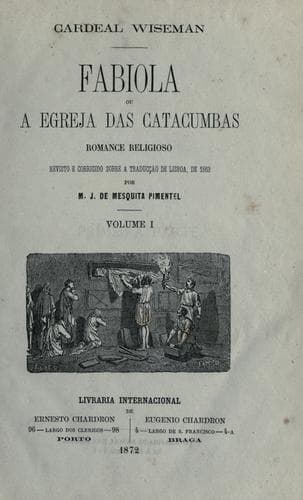
Fabiola; Or, The Church of the CatacombsWiseman, Nicholas Patrick
HistoryHistory
Fabiola; Or, The Church of the Catacombs
Wiseman, Nicholas Patrick
Christian fiction; Church history -- Primitive and early church, ca. 30-600 -- Fiction; Historical fiction
“Fabiola,” responded Miriam, “more learned teachers than I should
undertake the instruction of one so gifted and so acute. But will you
believe me if I attempt to give you some explanation?”
“Miriam,” replied Fabiola, with strong emphasis, “ONE WHO IS READY TO
DIE FOR ANOTHER, WILL CERTAINLY NOT DECEIVE HIM.”
“And now,” rejoined the patient, smiling, “you have again seized a great
principle--that of FAITH. I will, therefore, be only the simple narrator
of what Jesus Christ, who truly died for us, has taught us. You will
believe my word only as that of a faithful witness; you will accept His,
as that of an unerring God.”
Fabiola bowed her head, and listened with reverential mind to her, in
whom she had long honored a teacher of marvellous wisdom, which she drew
from some unknown school; but whom now she almost worshipped as an
angel, who could open to her the flood-gates of the eternal ocean, whose
waters are the unfathomable Wisdom, overflowing on earth.
Miriam expounded, in the simple terms of Catholic teaching, the sublime
doctrine of the Trinity; then after relating the fall of man, unfolded
the mystery of the Incarnation, giving, in the very words of St. John,
the history of the Eternal Word, till He was made flesh, and dwelt among
men. Often was she interrupted by the expressions of admiration or
assent which her pupil uttered; never by cavil or doubt. Philosophy had
given place to religion, captiousness to docility, incredulity to faith.
But now a sadness seemed to have come over Fabiola’s heart: Miriam read
it in her looks, and asked her its cause.
“I hardly dare tell you,” she replied. “But all that you have related to
me is so beautiful, so divine, that it seems to me necessarily to end
here.
“The Word (what a noble name!), that is, the expression of God’s love,
the externation of His wisdom, the evidence of His power, the very
breath of His life-giving life, which is Himself, becometh flesh. Who
shall furnish it to Him? Shall He take up the cast-off slough of a
tainted humanity, or shall a new manhood be created expressly for _Him_?
Shall He take His place in a double genealogy, receiving thus into
Himself a twofold tide of corruption; and shall there be any one on
earth daring and high enough to call himself His father?”
“No,” softly whispered Miriam; “but there shall be one holy enough, and
humble enough, to be worthy to call herself His mother!
“Almost 800 years before the Son of God came into the world, a prophet
spoke, and recorded his words, and deposited the record of them in the
hands of the Jews, Christ’s inveterate enemies; and his words were
these: ‘Behold, a Virgin shall conceive and bear a Son, and His name
shall be called Emanuel,’[219] which in the Hebrew language signifies
‘God with us,’ that is with men.
“This prophecy was of course fulfilled in the conception and birth of
God’s Son on earth.”
“And who was _she_?” asked Fabiola, with great reverence.
Public-domain text, read in full here on John Shaqi.
Reviews
Reviews
No reviews yet
Be the first to share your thoughts on this work.
Elsewhere in the archive
Join the Discussion
Join the discussion
Sign in to leave a comment or review.
Sign InorCreate an account