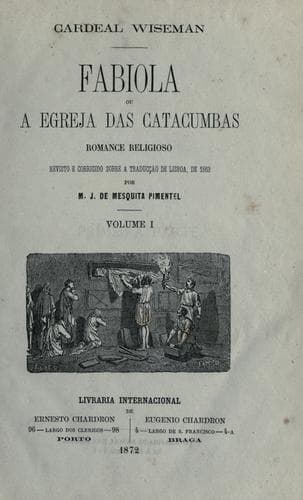
Fabiola; Or, The Church of the CatacombsWiseman, Nicholas Patrick
HistoryHistory
Fabiola; Or, The Church of the Catacombs
Wiseman, Nicholas Patrick
Christian fiction; Church history -- Primitive and early church, ca. 30-600 -- Fiction; Historical fiction
“One whose very name is blessed by every one that truly loves her Son.
Mary is the name by which you will know her: Miriam, its original in her
own tongue, is the one by which I honor her. Well, you may suppose, was
she prepared for such high destiny by holiness and virtue; not as
cleansed, but as ever clean; not as purified, but as always pure; not
freed, but exempted, from sin. The tide of which you spoke, found before
her the dam of an eternal decree, which could not brook that the
holiness of God should mingle with what it could only redeem, by keeping
extraneous to itself. Bright as the blood of Adam, when the breath of
God sent it sparkling through his veins, pure as the flesh of Eve, while
standing yet in the mould of the Almighty hands, as they drew it from
the side of the slumbering man, were the blood and the flesh, which the
Spirit of God formed into the glorious humanity, that Mary gave to
Jesus.
“And after this glorious privilege granted to our sex, are you surprised
that many, like your sweet Agnes, should have chosen this peerless
Virgin as the pattern of their lives; should find in her, whom God so
elected, the model of every virtue; and should, in preference to
allowing themselves to be yoked, even by the tenderest of ties, to the
chariot-wheels of this world, seek to fly upwards on wings of undivided
love like hers?”
After a pause and some reflection, Miriam proceeded briefly to detail
the history of our Saviour’s birth, His laborious youth, His active but
suffering public life, and then His ignominious Passion. Often was the
narrative interrupted by the tears and sobs of the willing listener and
ready learner. At last the time for rest had come, when Fabiola humbly
asked:
“Are you too fatigued to answer one question more?”
“No,” was the cheerful reply.
“What hope,” said Fabiola, “can there be for one who cannot say she was
ignorant, for she pretended to know every thing; nor that she neglected
to learn, for she affected eagerness after every sort of knowledge; but
can only confess that she scorned the true wisdom, and blasphemed its
Giver;--for one who has scoffed at the very torments which proved the
love, and sneered at the death which was the ransoming, of Him whom she
has mocked at, as the ‘Crucified?’”
A flood of tears stopped her speech.
Miriam waited till their relieving flow had subsided into that gentler
dew which softens the heart; then in soothing tones addressed her as
follows:
Public-domain text, read in full here on John Shaqi.
Reviews
Reviews
No reviews yet
Be the first to share your thoughts on this work.
Elsewhere in the archive
Join the Discussion
Join the discussion
Sign in to leave a comment or review.
Sign InorCreate an account