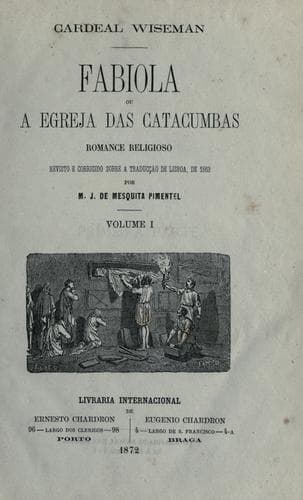
Fabiola; Or, The Church of the CatacombsWiseman, Nicholas Patrick
HistoryHistory
Fabiola; Or, The Church of the Catacombs
Wiseman, Nicholas Patrick
Christian fiction; Church history -- Primitive and early church, ca. 30-600 -- Fiction; Historical fiction
“In the days of our Lord there lived a woman who bore the same name as
His spotless Mother; but she had sinned publicly, degradingly, as you,
Fabiola, would abhor to sin. She became acquainted, we know not how,
with her Redeemer; in the secrecy of her own heart, she contemplated
earnestly, till she came to love intensely, His gracious and
condescending familiarity with sinners, and His singular indulgence and
forgivingness to the fallen. She loved and loved still more; and,
forgetting herself, she only thought how she might manifest her love, so
that it might bring honor, however slight, to Him, and shame, however
great, on herself.
“She went into the house of a rich man, where the usual courtesies of
hospitality had been withheld from its Divine guest, into the house of a
haughty man who spurned, in the presumption of his heart, the public
sinner; she supplied the attentions which had been neglected to Him whom
she loved; and she was scorned, as she expected, for her obtrusive
sorrow.”
“How did she do this, Miriam?”
“She knelt at His feet as He sat at table; she poured out upon them a
flood of tears; she wiped them with her luxurious hair, she kissed them
fervently, and she anointed them with rich perfume.”
“And what was the result?”
“She was defended by Jesus against the carping gibes of His host; she
was told that she was forgiven on account of her love, and was dismissed
with kindest comfort.”
“And what became of her?”
“When on Calvary He was crucified, two women were privileged to stand
close to Him; Mary the sinless, and Mary the penitent: to show how
unsullied and repentant love may walk hand in hand, beside Him who said
that He had ‘come to call not the just, but sinners to repentance.’”
No more was said that night. Miriam, fatigued with her exertion, sank
into a placid slumber. Fabiola sat by her side, filled to her heart’s
brim with this tale of love. She pondered over it again and again; and
she still saw more and more how every part of this wonderful system was
consistent. For if Miriam had been ready to die for her, in imitation of
her Saviour’s love, so had she been as ready to forgive her, when she
had thoughtlessly injured her. Every Christian, she now felt, ought to
be a copy, a representative of his Master; but the one that slumbered so
tranquilly beside her was surely true to her model, and might well
represent Him to her.
When, after some time, Miriam awoke, she found her mistress (for her
patent of freedom was not yet completed) lying at her feet, over which
she had sobbed herself to sleep. She understood at once the full meaning
and merit of this self-humiliation; she did not stir, but thanked God
with a full heart that her sacrifice had been accepted.
Public-domain text, read in full here on John Shaqi.
Reviews
Reviews
No reviews yet
Be the first to share your thoughts on this work.
Elsewhere in the archive
Join the Discussion
Join the discussion
Sign in to leave a comment or review.
Sign InorCreate an account