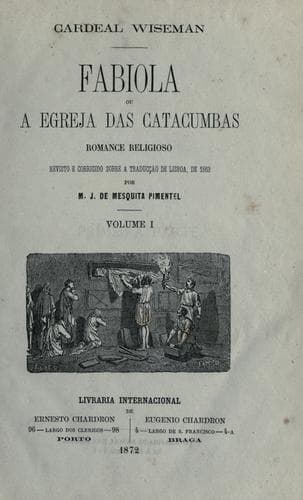
Fabiola; Or, The Church of the CatacombsWiseman, Nicholas Patrick
HistoryHistory
Fabiola; Or, The Church of the Catacombs
Wiseman, Nicholas Patrick
Christian fiction; Church history -- Primitive and early church, ca. 30-600 -- Fiction; Historical fiction
“For heaven’s sake, Agnes, do not take my words so seriously. I assure
you they were spoken in jest. I have too high an opinion of your good
sense to believe such a calamity possible. But as to Syra’s devotedness,
you are right. When last summer you were away, and I was so dangerously
ill of contagious fever, it required the lash to make the other slaves
approach me; while that poor thing would hardly leave me, but watched by
me, and nursed me day and night, and I really believe greatly promoted
my recovery.”
“And did you not love her for this?”
“Love her! Love a slave, child! Of course, I took care to reward her
generously; though I cannot make out what she does with what I give her.
The others tell me she has nothing put by, and she certainly spends
nothing on herself. Nay, I have even heard that she foolishly shares her
daily allowance of food with a blind beggar-girl. What a strange fancy,
to be sure!”
“Dearest Fabiola,” exclaimed Agnes, “she must be mine! You promised me
my request. Name your price, and let me take her home this evening.”
“Well, be it so, you most irresistible of petitioners. But we will not
bargain together. Send some one to-morrow, to see my father’s steward,
and all will be right. And now this great piece of business being
settled between us, let us go down to our guests.”
“But you have forgotten to put on your jewels.”
“Never mind them; I will do without them for once; I feel no taste for
them to-day.”
CHAPTER VI.
THE BANQUET.
They found, on descending, all the guests assembled in a hall below. It
was not a state banquet which they were going to share, but the usual
meal of a rich house, where preparation for a tableful of friends was
always made. We will therefore content ourselves with saying that every
thing was elegant and exquisite in arrangement and material; and we will
confine ourselves entirely to such incidents as may throw a light upon
our story.
When the two ladies entered the exedra or hall, Fabius, after saluting
his daughter, exclaimed, “Why, my child, you have come down, though
late, still scarcely fittingly arranged! You have forgotten your usual
trinkets.”
Fabiola was confused. She knew not what answer to make: she was ashamed
of her weakness about her angry display; and still more of what she now
thought a silly way of punishing herself for it. Agnes stepped in to the
rescue, and blushingly said: “It is my fault, cousin Fabius, both that
she is late and that she is so plainly dressed. I detained her with my
gossip, and no doubt she wishes to keep me in countenance by the
simplicity of her attire.”
Public-domain text, read in full here on John Shaqi.
Reviews
Reviews
No reviews yet
Be the first to share your thoughts on this work.
Join the Discussion
Join the discussion
Sign in to leave a comment or review.
Sign InorCreate an account