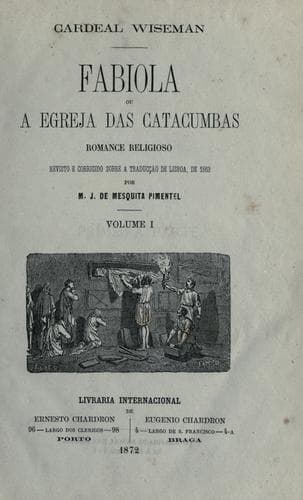
Fabiola; Or, The Church of the CatacombsWiseman, Nicholas Patrick
HistoryHistory
Fabiola; Or, The Church of the Catacombs
Wiseman, Nicholas Patrick
Christian fiction; Church history -- Primitive and early church, ca. 30-600 -- Fiction; Historical fiction
“You, dear Agnes,” replied the father, “are privileged to do as you
please. But, seriously speaking, I must say that, even with you, this
may have answered while you were a mere child; now that you are
marriageable,[23] you must begin to make a little more display, and try
to win the affections of some handsome and eligible youth. A beautiful
necklace, for instance, such as you have plenty of at home, would not
make you less attractive. But you are not attending to me. Come, come, I
dare say you have some one already in view.”
During most of this address, which was meant to be thoroughly
good-natured, as it was perfectly worldly, Agnes appeared in one of her
abstracted moods, her bewitched looks, as Fabiola called them,
transfixed, in a smiling ecstasy, as if attending to some one else, but
never losing the thread of the discourse, nor saying any thing out of
place. She therefore at once answered Fabius: “Oh, yes, most certainly,
one who has already pledged me to him by his betrothal-ring, and has
adorned me with immense jewels.”[24]
“Really!” asked Fabius, “with what?”
“Why,” answered Agnes, with a look of glowing earnestness, and in tones
of artless simplicity, “he has girded my hand and neck with precious
gems, and has set in my ears rings of peerless pearls.”[25]
“Goodness! who can it be? Come, Agnes, some day you must tell me your
secret. Your first love, no doubt; may it last long and make you happy!”
“For ever!” was her reply, as she turned to join Fabiola, and enter with
her into the dining-room. It was well she had not overheard this
dialogue, or she would have been hurt to the quick, as thinking that
Agnes had concealed the most important thought of her age, as she would
have considered it, from her most loving friend. But while Agnes was
defending her, she had turned away from her father, and had been
attending to the other guests. One was a heavy, thick-necked Roman
sophist, or dealer in universal knowledge, named Calpurnius; another,
Proculus, a mere lover of good fare, often at the house. Two more
remain, deserving further notice. The first of them, evidently a
favorite both with Fabiola and Agnes, was a tribune, a high officer of
the imperial or prætorian guard. Though not above thirty years of age,
he had already distinguished himself by his valor, and enjoyed the
highest favor with the emperors Dioclesian in the East, and Maximian
Herculius in Rome. He was free from all affectation in manner or dress,
though handsome in person; and though most engaging in conversation, he
manifestly scorned the foolish topics which generally occupied society.
In short, he was a perfect specimen of a noble-hearted youth, full of
honor and generous thoughts; strong and brave, without a particle of
pride or display in him.
Public-domain text, read in full here on John Shaqi.
Reviews
Reviews
No reviews yet
Be the first to share your thoughts on this work.
Join the Discussion
Join the discussion
Sign in to leave a comment or review.
Sign InorCreate an account