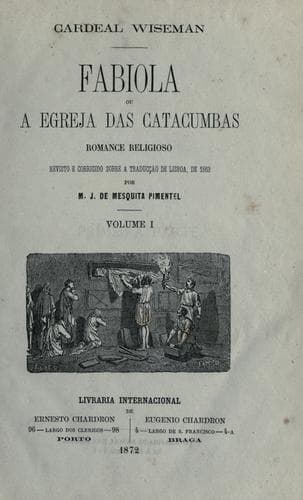
Fabiola; Or, The Church of the CatacombsWiseman, Nicholas Patrick
HistoryHistory
Fabiola; Or, The Church of the Catacombs
Wiseman, Nicholas Patrick
Christian fiction; Church history -- Primitive and early church, ca. 30-600 -- Fiction; Historical fiction
It has, therefore, been written at all sorts of times and in all sorts
of places; early and late, when no duty urged, in scraps and fragments
of time, when the body was too fatigued or the mind too worn for heavier
occupation; in the road-side inn, in the halt of travel, in strange
houses, in every variety of situation and circumstances--sometimes
trying ones. It has thus been composed bit by bit, in portions varying
from ten lines to half-a-dozen pages at most, and generally with few
books or resources at hand. But once begun, it has proved what it was
taken for,--a recreation, and often a solace and a sedative; from the
memories it has revived, the associations it has renewed, the scattered
and broken remnants of old studies and early readings which it has
combined, and by the familiarity which it has cherished with better
times and better things than surround us in our age.
Why need the reader be told all this? For two reasons:
First, this method of composition may possibly be reflected on the work;
and he may find it patchy and ill-assorted, or not well connected in its
parts. If so, this account will explain the cause.
Secondly, he will thus be led not to expect a treatise or a learned work
even upon ecclesiastical antiquities. Nothing would have been easier
than to cast an air of erudition over this little book, and fill half of
each page with notes and references. But this was never the writer’s
idea. His desire was rather to make his reader familiar with the usages,
habits, condition, ideas, feeling, and spirit of the early ages of
Christianity. This required a certain acquaintance with places and
objects connected with the period, and some familiarity, more habitual
than learned, with the records of the time. For instance, such writings
as the Acts of primitive Martyrs should have been frequently read, so as
to leave impressions on the author’s mind, rather than have been
examined scientifically and critically for mere antiquarian purposes.
And so, such places or monuments as have to be explained should seem to
stand before the eye of the describer, from frequently and almost
casually seeing them, rather than have to be drawn from books.
Public-domain text, read in full here on John Shaqi.
Reviews
Reviews
No reviews yet
Be the first to share your thoughts on this work.
Join the Discussion
Join the discussion
Sign in to leave a comment or review.
Sign InorCreate an account