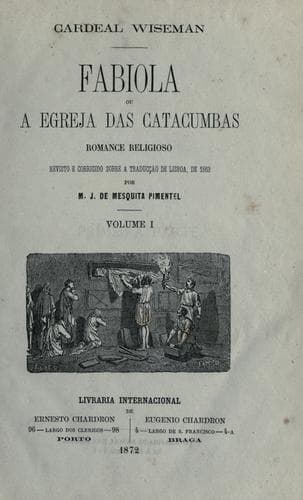
Fabiola; Or, The Church of the CatacombsWiseman, Nicholas Patrick
HistoryHistory
Fabiola; Or, The Church of the Catacombs
Wiseman, Nicholas Patrick
Christian fiction; Church history -- Primitive and early church, ca. 30-600 -- Fiction; Historical fiction
Another source of instruction has been freely used. Any one acquainted
with the Roman Breviary must have observed, that in the offices of
certain saints a peculiar style prevails, which presents the holy
persons commemorated in a distinct and characteristic form. This is not
the result so much of any continuous narrative, as of expressions put
into their mouths, or brief descriptions of events in their lives,
repeated often again and again, in antiphons, _responsoria_ to lessons,
and even versicles; till they put before us an individuality, a portrait
clear and definite of singular excellence. To this class belong the
offices of SS. Agnes, Agatha, Cæcilia, and Lucia; and those of St.
Clement and St. Martin. Each of these saints stands out before our minds
with distinct features; almost as if we had seen and known them.
If, for instance, we take the first that we have named, we clearly draw
out the following circumstances. She is evidently pursued by some
heathen admirer, whose suit for her hand she repeatedly rejects.
Sometimes she tells him that he is forestalled by another, to whom she
is betrothed; sometimes she describes this object of her choice under
various images, representing him even as the object of homage to sun and
moon. On another occasion she describes the rich gifts, or the beautiful
garlands with which he has adorned her, and the chaste caresses by which
he has endeared himself to her. Then at last, as if more importunately
pressed, she rejects the love of perishable man, “the food of death,”
and triumphantly proclaims herself the spouse of Christ. Threats are
used; but she declares herself under the protection of an angel who will
shield her.
This history is as plainly written by the fragments of her office, as a
word is by scattered letters brought, and joined together. But
throughout, one discerns another peculiarity, and a truly beautiful one
in her character. It is clearly represented to us, that the saint had
ever before her the unseen Object of her love, saw Him, heard Him, felt
Him, and entertained, and had returned, a real affection, such as hearts
on earth have for one another. She seems to walk in perpetual vision,
almost in ecstatic fruition, of her Spouse’s presence. He has actually
put a ring upon her finger, has transferred the blood from His own cheek
to hers, has crowned her with budding roses. Her eye is really upon Him,
with unerring gaze, and returned looks of gracious love.
Public-domain text, read in full here on John Shaqi.
Reviews
Reviews
No reviews yet
Be the first to share your thoughts on this work.
Join the Discussion
Join the discussion
Sign in to leave a comment or review.
Sign InorCreate an account