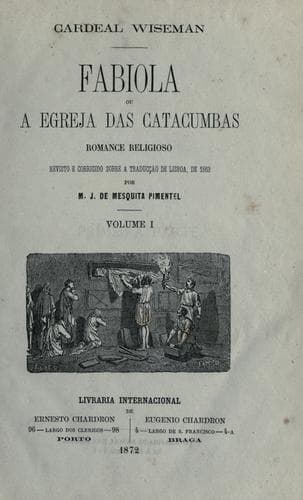
Fabiola; Or, The Church of the CatacombsWiseman, Nicholas Patrick
HistoryHistory
Fabiola; Or, The Church of the Catacombs
Wiseman, Nicholas Patrick
Christian fiction; Church history -- Primitive and early church, ca. 30-600 -- Fiction; Historical fiction
However necessary this prudential course might be, to prevent any wanton
persecution, its consequences fell often heavily upon those who held it.
The heathen world, the world of power, of influence, and of state, the
world which made laws as best suited it, and executed them, the world
that loved earthly prosperity and hated faith, felt itself surrounded,
filled, compenetrated by a mysterious system, which spread, no one could
see how, and exercised an influence derived no one knew whence. Families
were startled at finding a son or daughter to have embraced this new
law, with which they were not aware that they had been in contact, and
which, in their heated fancies and popular views, they considered
stupid, grovelling, and anti-social. Hence the hatred of Christianity
was political as well as religious; the system was considered as
un-Roman, as having an interest opposed to the extension and prosperity
of the empire, and as obeying an unseen and spiritual power. The
Christians were pronounced _irreligiosi in Cæsares_, “disloyal to the
emperors,” and that was enough. Hence their security and peace depended
much upon the state of popular feeling; when any demagogue or fanatic
could succeed in rousing this, neither their denial of the charges
brought against them, nor their peaceful demeanor, nor the claims of
civilized life, could suffice to screen them from such measure of
persecution as could be safely urged against them.
After these digressive remarks, we will resume, and unite again the
broken thread of our narrative.
[Illustration: A Monogram of Christ.]
CHAPTER XII.
THE WOLF AND THE FOX.
The hints of the African slave had not been thrown away upon the sordid
mind of Corvinus. Her own hatred of Christianity arose from the
circumstance, that a former mistress of hers had become a Christian and
had manumitted all her other slaves; but, feeling it wrong to turn so
dangerous a character as Afra, or rather Jubala (her proper name), upon
the world, had transferred her to another proprietor.
Corvinus had often seen Fulvius at the baths and other places of public
resort, had admired and envied him, for his appearance, his dress, his
conversation. But with his untoward shyness, or moroseness, he could
never have found courage to address him, had he not now discovered, that
though a more refined, he was not a less profound, villain than himself.
Fulvius’s wit and cleverness might supply the want of these qualities in
his own sottish composition, while his own brute force, and unfeeling
recklessness, might be valuable auxiliaries to those higher gifts. He
had the young stranger in his power, by the discovery which he had made
of his real character. He determined, therefore, to make an effort, and
enter into alliance with one who otherwise might prove a dangerous
rival.
Public-domain text, read in full here on John Shaqi.
Reviews
Reviews
No reviews yet
Be the first to share your thoughts on this work.
Elsewhere in the archive
Join the Discussion
Join the discussion
Sign in to leave a comment or review.
Sign InorCreate an account