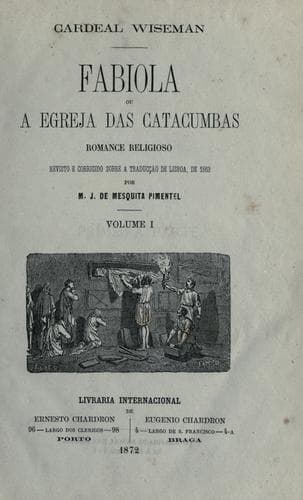
Fabiola; Or, The Church of the CatacombsWiseman, Nicholas Patrick
HistoryHistory
Fabiola; Or, The Church of the Catacombs
Wiseman, Nicholas Patrick
Christian fiction; Church history -- Primitive and early church, ca. 30-600 -- Fiction; Historical fiction
What writer that introduced the person would venture to alter the
character? Who would presume to attempt one at variance with it? Or who
would hope to draw a portrait more life-like and more exquisite than the
Church has done? For, putting aside all inquiry as to the genuineness of
the acts by which these passages are suggested; and still more waving
the question whether the hard critical spirit of a former age too
lightly rejected such ecclesiastical documents, as Guéranger thinks; it
is clear that the Church, in her office, intends to place before us a
certain type of high virtue embodied in the character of that saint. The
writer of the following pages considered himself therefore bound to
adhere to this view.
Whether these objects have been attained, it is for the reader to judge.
At any rate, even looking at the amount of information to be expected
from a work in this form, and one intended for general reading, a
comparison between the subjects introduced, either formally or casually,
and those given in any elementary work, such as Fleury’s _Manners of the
Christians_, which embraces several centuries more, will show that as
much positive knowledge on the practices and belief of that early period
is here imparted, as it is usual to communicate in a more didactic form.
At the same time, the reader must remember that this book is not
historical. It takes in but a period of a few months, extended in some
concluding chapters. It consists rather of a series of pictures than of
a narrative of events. Occurrences, therefore, of different epochs and
different countries have been condensed into a small space. Chronology
has been sacrificed to this purpose. The date of Dioclesian’s edict has
been anticipated by two months; the martyrdom of St. Agnes by a year;
the period of St. Sebastian, though uncertain, has been brought down
later. All that relates to Christian topography has been kept as
accurate as possible. A martyrdom has been transferred from Imola to
Fondi.
[Illustration: The Bark of Peter, as found in the Catacombs.]
It was necessary to introduce some view of the morals and opinions of
the Pagan world, as a contrast to those of Christians. But their worst
aspect has been carefully suppressed, as nothing could be admitted here
which the most sensitive Catholic eye would shrink from contemplating.
It is indeed earnestly desired that this little work, written solely for
recreation, be read also as a relaxation from graver pursuits; but that,
at the same time, the reader may rise from its perusal with a feeling
that his time has not been lost, nor his mind occupied with frivolous
ideas. Rather let it be hoped, that some admiration and love may be
inspired by it of those primitive times, which an over-excited interest
in later and more brilliant epochs of the Church is too apt to diminish
or obscure.
CONTENTS.
PAGE
Public-domain text, read in full here on John Shaqi.
Reviews
Reviews
No reviews yet
Be the first to share your thoughts on this work.
Join the Discussion
Join the discussion
Sign in to leave a comment or review.
Sign InorCreate an account