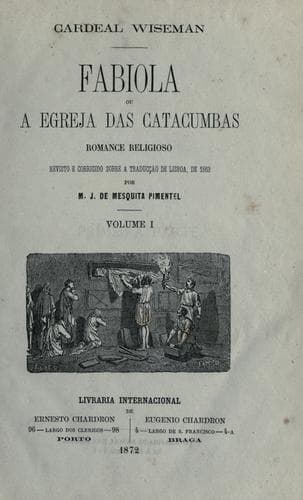
Fabiola; Or, The Church of the CatacombsWiseman, Nicholas Patrick
HistoryHistory
Fabiola; Or, The Church of the Catacombs
Wiseman, Nicholas Patrick
Christian fiction; Church history -- Primitive and early church, ca. 30-600 -- Fiction; Historical fiction
It was about ten days after the meeting last described, that Corvinus
went to stroll in Pompey’s gardens. These covered the space round his
theatre, in the neighborhood of the present Piazza Farnese. A
conflagration in the reign of Carinus had lately destroyed the scene, as
it was called, of the edifice, and Dioclesian had repaired it with great
magnificence. The gardens were distinguished from others by rows of
plane-trees, which formed a delicious shade. Statues of wild beasts,
fountains, and artificial brooks, profusely adorned them. While
sauntering about, Corvinus caught a sight of Fulvius, and made up to
him.
[Illustration: Roman Gardens, from an old painting.]
“What do you want with me?” asked the foreigner, with a look of surprise
and scorn at the slovenly dress of Corvinus.
“To have a talk with you, which may turn out to your advantage--and
mine.”
“What can you propose to me, with the first of these recommendations? No
doubt at all as to the second.”
“Fulvius, I am a plain-spoken man, and have no pretensions to your
cleverness and elegance; but we are both of one trade, and both
consequently of one mind.”
Fulvius started, and deeply colored; then said, with a contemptuous air,
“What do you mean, sirrah?”
“If you double your fist,” rejoined Corvinus, “to show me the fine rings
on your delicate fingers, it is very well. But if you mean to threaten
by it, you may as well put your hand again into the folds of your toga.
It is more graceful.”
“Cut this matter short, sir. Again I ask, what do you mean?”
“This, Fulvius,” and he whispered into his ear, “that you are a spy and
an informer.”
Fulvius was staggered; then rallying, said, “What right have you to make
such an odious charge against me?”
“You _discovered_” (with a strong emphasis) “a conspiracy in the East,
and Dioclesian--”
Fulvius stopped him, and asked, “What is your name, and who are you?”
“I am Corvinus, the son of Tertullus, prefect of the city.”
This seemed to account for all; and Fulvius said, in subdued tones, “No
more here; I see friends coming. Meet me disguised at daybreak to-morrow
in the Patrician Street,[50] under the portico of the Baths of Novatus.
We will talk more at leisure.”
Corvinus returned home, not ill-satisfied with his first attempt at
diplomacy; he procured a garment shabbier than his own from one of his
father’s slaves, and was at the appointed spot by the first dawn of day.
He had to wait a long time, and had almost lost patience, when he saw
his new friend approach.
Fulvius was well wrapped up in a large overcoat, and wore its hood over
his face. He thus saluted Corvinus:
“Good morning, comrade; I fear I have kept you waiting in the cold
morning air, especially as you are thinly clad.”
“I own,” replied Corvinus, “that I should have been tired, had I not
been immensely amused and yet puzzled, by what I have been observing.”
“What is that?”
Public-domain text, read in full here on John Shaqi.
Reviews
Reviews
No reviews yet
Be the first to share your thoughts on this work.
Elsewhere in the archive
Join the Discussion
Join the discussion
Sign in to leave a comment or review.
Sign InorCreate an account