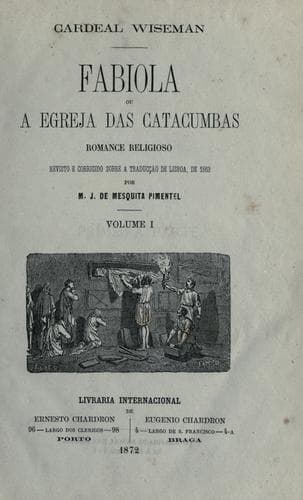
Fabiola; Or, The Church of the CatacombsWiseman, Nicholas Patrick
HistoryHistory
Fabiola; Or, The Church of the Catacombs
Wiseman, Nicholas Patrick
Christian fiction; Church history -- Primitive and early church, ca. 30-600 -- Fiction; Historical fiction
“Why, from an early hour, long, I suspect, before my coming, there have
been arriving here from every side, and entering into that house, by the
back door in the narrow street, the rarest collection of miserable
objects that you ever saw; the blind, the lame, the maimed, the
decrepit, the deformed of every possible shape; while by the front door
several persons have entered, evidently of a different class.”
“Whose dwelling is it, do you know? It looks a large old house, but
rather out of condition.”
“It belongs to a very rich, and, it is said, very miserly old patrician.
But look! there come some more.”
At that moment a very feeble man, bent down by age, was approaching,
supported by a young and cheerful girl, who chatted most kindly to him
as she supported him.
“We are just there,” she said to him; “a few more steps, and you shall
sit down and rest.”
“Thank you, my child,” replied the poor old man, “how kind of you to
come for me so early!”
“I knew,” she said, “you would want help; and as I am the most useless
person about, I thought I would go and fetch you.”
“I have always heard that blind people are selfish, and it seems but
natural; but you, Cæcilia, are certainly an exception.”
“Not at all; this is only _my_ way of showing selfishness.”
“How do you mean?”
“Why, first, I get the advantage of your eyes, and then I get the
satisfaction of supporting you. ‘I was an eye to the blind,’ that is
you; and ‘a foot to the lame,’ that is myself.”[51]
They reached the door as she spoke these words.
“That girl is blind,” said Fulvius to Corvinus. “Do you not see how
straight she walks, without looking right or left?”
“So she is,” answered the other. “Surely this is not the place so often
spoken of, where beggars meet, and the blind see, and the lame walk,
and all feast together? But yet I observed these people were so
different from the mendicants on the Arician bridge.[52] They appeared
respectable and even cheerful; and not one asked me for alms as he
passed.”
“It is very strange; and I should like to discover the mystery. A good
job might, perhaps, be got out of it. The old patrician, you say, is
very rich?”
“Immensely!”
“Humph! How could one manage to get in?”
“I have it! I will take off my shoes, screw up one leg like a cripple,
and join the next group of queer ones that come, and go boldly in, doing
as they do.”
“That will hardly succeed; depend upon it every one of these people is
known at the house.”
“I am sure not, for several of them asked me if this was the house of
the Lady Agnes.”
“Of whom?” asked Fulvius, with a start.
“Why do you look so?” said Corvinus. “It is the house of her parents:
but she is better known than they, as being a young heiress, nearly as
rich as her cousin Fabiola.”
Fulvius paused for a moment; a strong suspicion, too subtle and
important to be communicated to his rude companion, flashed through his
mind. He said, therefore, to Corvinus:
Public-domain text, read in full here on John Shaqi.
Reviews
Reviews
No reviews yet
Be the first to share your thoughts on this work.
Elsewhere in the archive
Join the Discussion
Join the discussion
Sign in to leave a comment or review.
Sign InorCreate an account