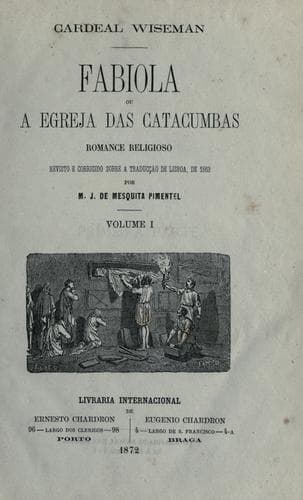
Fabiola; Or, The Church of the CatacombsWiseman, Nicholas Patrick
HistoryHistory
Fabiola; Or, The Church of the Catacombs
Wiseman, Nicholas Patrick
Christian fiction; Church history -- Primitive and early church, ca. 30-600 -- Fiction; Historical fiction
The handmaid did as she was told, looked at the title of the proposed
volume, and blushed. She glanced over the few first lines, and her fears
were confirmed. She saw that it was one of those trashy works, which
were freely allowed to circulate, as St. Justin complained, though
grossly immoral, and making light of all virtue; while every Christian
writing was suppressed, or as much as possible discountenanced. She put
down the book with a calm resolution, and said:
“Do not, my good mistress, ask me to read to you from that book. It is
fit neither for me to recite, nor for you to hear.”
Fabiola was astonished. She had never heard, or even thought, of such a
thing as restraint put upon her studies. What in our days would be
looked upon as unfit for common perusal, formed part of current and
fashionable literature. From Horace to Ausonius, all classical writers
demonstrate this. And what rule of virtue could have made that reading
seem indelicate, which only described by the pen a system of morals,
which the pencil and the chisel made hourly familiar to every eye?
Fabiola had no higher standard of right and wrong than the system under
which she had been educated could give her.
“What possible harm can it do either of us?” she asked, smiling. “I have
no doubt there are plenty of foul crimes and wicked actions described in
the book; but it will not induce us to commit them. And, in the
meantime, it is amusing to read them of others.”
“Would you yourself, for any consideration, do them?”
“Not for the world.”
“Yet, as you hear them read, their image must occupy your mind; as they
amuse you, your thoughts must dwell upon them with pleasure.”
“Certainly. What then?”
“That image is foulness, that thought is wickedness.”
“How is that possible? Does not wickedness require an action, to have
any existence?”
“True, my mistress; and what is the action of the mind, or as I call it
the soul, but thought? A passion which wishes death, is the action of
this invisible power, like it, unseen; the blow which inflicts it is but
the mechanical action of the body, discernible like its origin. But
which power commands, and which obeys? In which resides the
responsibility of the final effect?”
“I understand you,” said Fabiola, after a pause of some little
mortification. “But one difficulty remains. There is responsibility, you
maintain, for the inward, as well as the outward act. To whom? If the
second follow, there is joint responsibility for both, to society, to
the laws, to principles of justice, to self; for painful results will
ensue. But if only the inward action exist, to whom can there be
responsibility? Who sees it? Who can presume to judge it? Who to
control it?”
“God,” answered Syra, with simple earnestness.
Public-domain text, read in full here on John Shaqi.
Reviews
Reviews
No reviews yet
Be the first to share your thoughts on this work.
Elsewhere in the archive
Join the Discussion
Join the discussion
Sign in to leave a comment or review.
Sign InorCreate an account