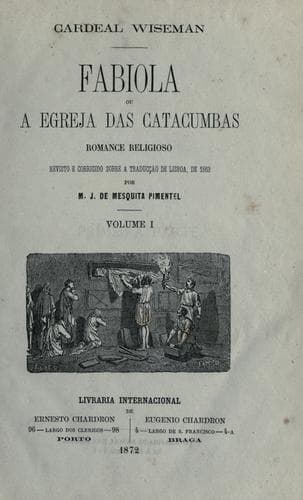
Fabiola; Or, The Church of the CatacombsWiseman, Nicholas Patrick
HistoryHistory
Fabiola; Or, The Church of the Catacombs
Wiseman, Nicholas Patrick
Christian fiction; Church history -- Primitive and early church, ca. 30-600 -- Fiction; Historical fiction
Fabiola was disappointed. She expected some new theory, some striking
principle, to come out. Instead, they had sunk down into what she feared
was mere superstition, though not so much as she once had deemed it.
“What, Syra, do you then really believe in Jupiter, and Juno, or perhaps
Minerva, who is about the most respectable of the Olympian family? Do
you think they have any thing to do with our affairs?”
“Far indeed from it; I loathe their very names, and I detest the
wickedness which their histories or fables symbolize on earth. No, I
spoke not of gods and goddesses, but of one only God.”
“And what do you call Him, Syra, in your system?”
“He has no name but GOD; and that only men have given Him, that they may
speak of Him. It describes not His nature, His origin, His attributes.”
“And what are these?” asked the mistress, with awakened curiosity.
“Simple as light is His nature, one and the same every where,
indivisible, undefilable, penetrating yet diffusive, ubiquitous and
unlimited. He existed before there was any beginning; He will exist
after all ending has ceased. Power, wisdom, goodness, love, justice too,
and unerring judgment belong to Him by His nature, and are as unlimited
and unrestrained as it. He alone can create, He alone preserve, and He
alone destroy.”
Fabiola had often read of the inspired looks which animated a sibyl, or
the priestess of an oracle; but she had never witnessed them till now.
The slave’s countenance glowed, her eyes shone with a calm brilliancy,
her frame was immovable, the words flowed from her lips, as if these
were but the opening of a musical reed, made vocal by another’s breath.
[Illustration: Interior of the Temple of Jupiter.]
Her expression and manner forcibly reminded Fabiola of that abstracted
and mysterious look, which she had so often noticed in Agnes; and though
in the child it was more tender and graceful, in the maid it seemed more
earnest and oracular. “How enthusiastic and excitable an Eastern
temperament is, to be sure!” thought Fabiola, as she gazed upon her
slave. “No wonder the East should be thought the land of poetry and
inspiration.” When she saw Syra relaxed from the evident tension of her
mind, she said, in as light a tone as she could assume: “But, Syra, can
you think that a Being such as you have described, far beyond all the
conception of ancient fable, can occupy Himself with constantly watching
the actions, still more the paltry thoughts, of millions of creatures?”
Public-domain text, read in full here on John Shaqi.
Reviews
Reviews
No reviews yet
Be the first to share your thoughts on this work.
Elsewhere in the archive
Join the Discussion
Join the discussion
Sign in to leave a comment or review.
Sign InorCreate an account