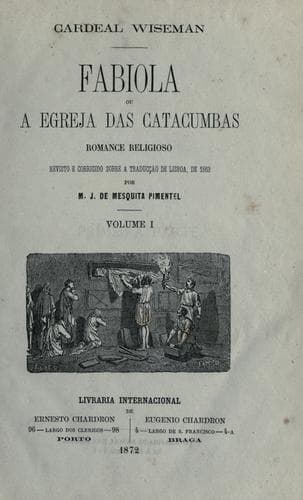
Fabiola; Or, The Church of the CatacombsWiseman, Nicholas Patrick
HistoryHistory
Fabiola; Or, The Church of the Catacombs
Wiseman, Nicholas Patrick
Christian fiction; Church history -- Primitive and early church, ca. 30-600 -- Fiction; Historical fiction
“It is no occupation, lady, it is not even choice. I called Him light.
Is it occupation or labor to the sun to send his rays through the
crystal of this fountain, to the very pebbles in its bed? See how, of
themselves they disclose, not only the beautiful, but the foul that
harbors there; not only the sparkles that the falling drops strike from
its rough sides; not only the pearly bubbles that merely rise, glisten
for a moment, then break against the surface; not only the golden fish
that bask in their light, but black and loathsome creeping things, which
seek to hide and bury themselves in dark nooks below, and cannot; for
the light pursues them. Is there toil or occupation in all this, to the
sun that thus visits them? Far more would it appear so, were he to
restrain his beams at the surface of the transparent element, and hold
them back from throwing it into light. And what he does here he does in
the next stream, and in that which is a thousand miles off, with equal
ease; nor can any imaginable increase of their number, or bulk, lead us
to fancy, or believe, that rays would be wanting, or light would fail,
to scrutinize them all.”
“Your theories are beautiful always, Syra, and, if true, most
wonderful,” observed Fabiola, after a pause, during which her eyes were
fixedly contemplating the fountain, as though she were testing the truth
of Syra’s words.
“And they sound like truth,” she added; “for could falsehood be more
beautiful than truth? But what an awful idea, that one has _never_ been
alone, has never had a wish to oneself, has never held a single thought
in secret, has never hidden the most foolish fancy of a proud or
childish brain, from the observation of One that knows no imperfection.
Terrible thought, that one is living, if you say true, under the steady
gaze of an Eye, of which the sun is but a shadow, for he enters not the
soul! It is enough to make one any evening commit self-destruction, to
get rid of the torturing watchfulness! Yet it sounds so true!”
Fabiola looked almost wild as she spoke these words. The pride of her
pagan heart rose strong within her, and she rebelled against the
supposition that she could never again feel alone with her own thoughts,
or that any power should exist which could control her inmost desires,
imaginings, or caprices. Still the thought came back: “Yet it seems so
true!” Her generous intellect struggled against the writhing passion,
like an eagle with a serpent; more with eye, than with beak and talons,
subduing the quailing foe. After a struggle, visible in her countenance
and gestures, a calm came over her. She seemed for the first time to
feel the presence of One greater than herself, some one whom she feared,
yet whom she would wish to love. She bowed down her mind, she bent her
intelligence to His feet; and her heart too owned, for the first time,
that it had a Master, and a Lord.
Public-domain text, read in full here on John Shaqi.
Reviews
Reviews
No reviews yet
Be the first to share your thoughts on this work.
Elsewhere in the archive
Join the Discussion
Join the discussion
Sign in to leave a comment or review.
Sign InorCreate an account