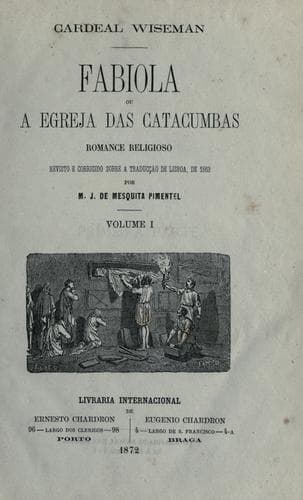
Fabiola; Or, The Church of the CatacombsWiseman, Nicholas Patrick
HistoryHistory
Fabiola; Or, The Church of the Catacombs
Wiseman, Nicholas Patrick
Christian fiction; Church history -- Primitive and early church, ca. 30-600 -- Fiction; Historical fiction
Syra, with calm intensity of feeling, silently watched the workings of
her mistress’s mind. She knew how much depended on their issue, what a
mighty step in her unconscious pupil’s religious progress was involved
in the recognition of the truth before her; and she fervently prayed for
this grace.
At length Fabiola raised her head, which seemed to have been bowed down
in accompaniment to her mind, and with graceful kindness said:
“Syra, I am sure I have not yet reached the depths of your knowledge;
you must have much more to teach me.” (A tear and a blush came to the
poor handmaid’s relief.) “But to-day you have opened a new world, and a
new life, to my thoughts. A sphere of virtue beyond the opinions and the
judgments of men, a consciousness of a controlling, an approving, and a
_rewarding_ Power too; am I right?” (Syra expressed approbation,)
“standing by us when no other eye can see, or restrain, or encourage us;
a feeling that, were we shut up forever in solitude, we should be ever
the same, because that influence on us must be so superior to that of
any amount of human principles, in guiding us, and could not leave us;
such, if I understand your theory, is the position of moral elevation,
in which it would place each individual. To fall below it, even with an
outwardly virtuous life, is mere deceit, and positive wickedness. Is
this so?”
“O my dear mistress,” exclaimed Syra, “how much better you can express
all this than I!”
“You have never flattered me yet, Syra,” replied Fabiola, smilingly; “do
not begin now. But you have thrown a new light upon other subjects, till
to-day obscure to me. Tell me, now, was it not this you meant, when you
once told me that in your view there was no distinction between mistress
and slave; that is, that as the distinction is only outward, bodily and
social, it is not to be put in comparison with that equality which
exists before your Supreme Being, and that possible moral superiority
which He might see of the one over the other, inversely of their visible
rank?”
“It was in a great measure so, my noble lady; though there are other
considerations involved in the idea, which would hardly interest you at
present.”
“And yet, when you stated that proposition, it seemed to me so
monstrous, so absurd, that pride and anger overcame me. Do you remember
that, Syra?”
“Oh, no, no!” replied the gentle servant; “do not allude to it, I pray!”
“Have you forgiven me that day, Syra?” said the mistress, with an
emotion quite new to her.
The poor maid was overpowered. She rose and threw herself on her knees
before her mistress, and tried to seize her hand; but she prevented her,
and, for the first time in her life, Fabiola threw herself upon a
slave’s neck, and wept.
Her passion of tears was long and tender. Her heart was getting above
her intellect; and this can only be by its increasing softness. At
length she grew calm; and as she withdrew her embrace she said:
Public-domain text, read in full here on John Shaqi.
Reviews
Reviews
No reviews yet
Be the first to share your thoughts on this work.
Elsewhere in the archive
Join the Discussion
Join the discussion
Sign in to leave a comment or review.
Sign InorCreate an account