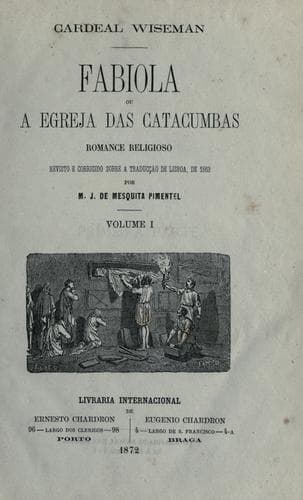
Fabiola; Or, The Church of the CatacombsWiseman, Nicholas Patrick
HistoryHistory
Fabiola; Or, The Church of the Catacombs
Wiseman, Nicholas Patrick
Christian fiction; Church history -- Primitive and early church, ca. 30-600 -- Fiction; Historical fiction
“One thing more, Syra: dare one address, by worship, this Being whom you
have described to me? Is He not too great, too lofty, too distant for
this?”
“Oh, no! far from it, noble lady,” answered the servant. “He is not
distant from any of us; for as much as in the light of the sun, so in
the very splendor of His might, His kindness, and His wisdom, we live
and move and have our being. Hence, one may address Him, not as far off,
but as around us and within us, while we are in Him; and He hears us not
with ears, but our words drop at once into His very bosom, and the
desires of our hearts pass directly into the divine abyss of His.”
“But,” pursued Fabiola, somewhat timidly, “is there no great act of
acknowledgment, such as sacrifice is supposed to be, whereby He may be
formally recognized and adored?”
Syra hesitated, for the conversation seemed to be trenching upon
mysterious and sacred ground, never opened by the Church to profane
foot. She, however, answered in a simple and general affirmative.
“And could not I,” still more humbly asked her mistress, “be so far
instructed in your school as to be able to perform this sublimer act of
homage?”
“I fear not, noble Fabiola; one must needs obtain a Victim worthy of the
Deity.”
“Ah, yes! to be sure,” answered Fabiola. “A bull may be good enough for
Jupiter, or a goat for Bacchus; but where can be found a sacrifice
worthy of Him whom you have brought me to know?”
“It must indeed be one every way worthy of Him, spotless in purity,
matchless in greatness, unbounded in acceptableness.”
“And what can that be, Syra?”
“Only Himself.”
Fabiola shrouded her face with her hands, and then looking up earnestly
into Syra’s face, said to her:
“I am sure that, after having so clearly described to me the deep sense
of responsibility under which you must habitually speak, as well as act,
you have a real meaning in this awful saying, though I understand you
not.”
“As surely as every word of mine is heard, as every thought of mine is
seen, it is a truth which I have spoken.”
“I have not strength to carry the subject further at present; my mind
has need of rest.”
[Illustration: A Monogram of Christ, found in the Catacombs.]
CHAPTER XVII.
THE CHRISTIAN COMMUNITY.
Public-domain text, read in full here on John Shaqi.
Reviews
Reviews
No reviews yet
Be the first to share your thoughts on this work.
Elsewhere in the archive
Join the Discussion
Join the discussion
Sign in to leave a comment or review.
Sign InorCreate an account