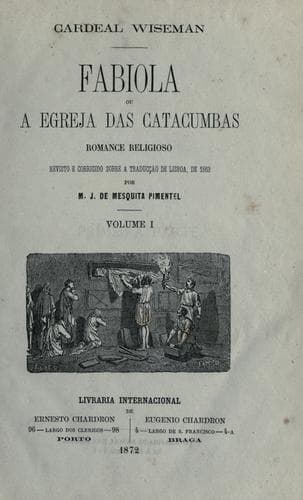
Fabiola; Or, The Church of the CatacombsWiseman, Nicholas Patrick
HistoryHistory
Fabiola; Or, The Church of the Catacombs
Wiseman, Nicholas Patrick
Christian fiction; Church history -- Primitive and early church, ca. 30-600 -- Fiction; Historical fiction
After this conversation Fabiola retired; and during the rest of the day
her mind was alternately agitated and calm. When she looked steadily on
the grand view of moral life which her mind had grasped, she found an
unusual tranquillity in its contemplation; she felt as if she had made
discovery of a great phenomenon, the knowledge of which guided her into
a new and lofty region, whence she could smile on the errors and follies
of mankind. But when she considered the responsibility which this light
imposed, the watchfulness which it demanded, the unseen and unrequited
struggles which it required, the desolateness, almost, of a virtue
without admiration or even sympathy, she again shrunk from the life that
was before her, as about to be passed without any stay or help, from the
only sources of it which she knew. Unconscious of the real cause, she
saw that she possessed not instruments or means, to carry out the
beautiful theory. This seemed to stand like a brilliant lamp in the
midst of a huge, bare, unfurnished hall, lighting up only a wilderness.
What was the use of so much wasted splendor?
The next morning had been fixed for one of those visits which used to be
annually paid in the country,--that to the now ex-prefect of the city,
Chromatius. Our reader will remember, that after his conversion and
resignation of office, this magistrate had retired to his villa in
Campania, taking with him a number of the converts made by Sebastian,
with the holy priest Polycarp, to complete their instruction. Of these
circumstances, of course, Fabiola had never been informed; but she heard
all sorts of curious reports about Chromatius’s villa. It was said that
he had a number of visitors never before seen at his house; that he gave
no entertainments; that he had freed all his country slaves, but that
many of them had preferred remaining with him; that if numerous, the
whole establishment seemed very happy, though no boisterous sports or
frolicsome meetings seemed to be indulged in. All this stimulated
Fabiola’s curiosity, in addition to her wish to discharge a pleasing
duty of courtesy to a most kind friend of hers from childhood; and she
longed to see, with her own eyes, what appeared to her to be a very
Platonic, or, as we should say, Utopian, experiment.
Public-domain text, read in full here on John Shaqi.
Reviews
Reviews
No reviews yet
Be the first to share your thoughts on this work.
Elsewhere in the archive
Join the Discussion
Join the discussion
Sign in to leave a comment or review.
Sign InorCreate an account