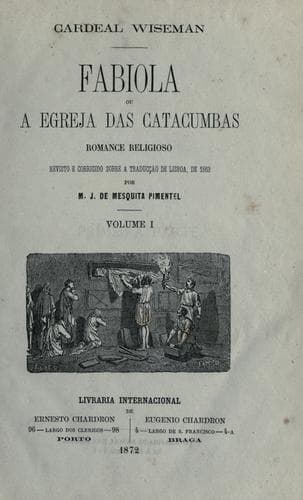
Fabiola; Or, The Church of the CatacombsWiseman, Nicholas Patrick
HistoryHistory
Fabiola; Or, The Church of the Catacombs
Wiseman, Nicholas Patrick
Christian fiction; Church history -- Primitive and early church, ca. 30-600 -- Fiction; Historical fiction
In a light country carriage, with good horses, Fabiola started early,
and dashed gaily along the level road across the “happy Campania.” An
autumnal shower had laid the dust, and studded with glistening gems the
garlands of vine which bordered the way, festooned, instead of hedges,
from tree to tree. It was not long before she reached the gentle
acclivity, for hill it could scarce be called, covered with box,
arbutus, and laurels, relieved by tall tapering cypresses, amidst which
shone the white walls of the large villa on the summit. A change, she
perceived, had taken place, which at first she could not exactly define;
but when she had passed through the gate, the number of empty pedestals
and niches reminded her that the villa had entirely lost one of its most
characteristic ornaments,--the number of beautiful statues which stood
gracefully against the clipped evergreen hedges, and gave it the name,
now become quite an empty one, of _Ad Statuas_.[64]
Chromatius, whom she had last seen limping with gout, now a hale old
man, courteously received her, and inquired kindly after her father,
asking if the report were true that he was going shortly to Asia. At
this Fabiola seemed grieved and mortified; for he had not mentioned his
intention to her. Chromatius hoped it might be a false alarm, and asked
her to take a stroll about the grounds. She found them kept with the
same care as ever, full of beautiful plants; but still much missed the
old statues. At last they reached a grotto with a fountain, in which
formerly nymphs and sea-deities disported, but which now presented a
black unbroken surface. She could contain herself no longer, and turning
to Chromatius, she said:
“Why, what on earth have you been doing, Chromatius, to send away all
your statues, and destroy the peculiar feature of your handsome villa?
What induced you to do this?”
“My dear young lady,” answered the good-humored old gentleman, “do not
be so angry. Of what use were those figures to any one?”
“If you thought so,” replied she, “others might not. But tell me, what
have you done with them all?”
“Why, to tell you the truth, I have had them brought under the hammer.”
“What! and never let me know any thing about it? You know there were
several pieces I would most gladly have purchased.”
Chromatius laughed outright, and said, with that familiar tone, which
acquaintance with Fabiola from a child authorized him always to assume
with her:
“Dear me! how your young imagination runs away, far too fast for my poor
old tongue to keep pace with; I meant not the auctioneer’s hammer, but
the sledge-hammer. The gods and goddesses have been all smashed,
pulverized! If you happen to want a stray leg, or a hand minus a few
fingers, perhaps I may pick up such a thing for you. But I cannot
promise you a face with a nose, or a skull without a fracture.”
Public-domain text, read in full here on John Shaqi.
Reviews
Reviews
No reviews yet
Be the first to share your thoughts on this work.
Elsewhere in the archive
Join the Discussion
Join the discussion
Sign in to leave a comment or review.
Sign InorCreate an account