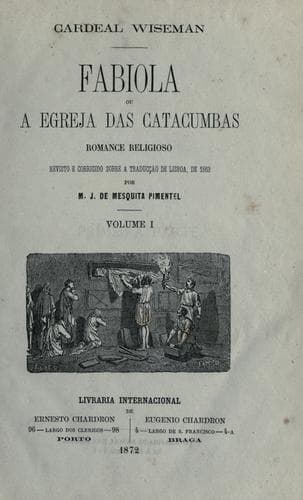
Fabiola; Or, The Church of the CatacombsWiseman, Nicholas Patrick
HistoryHistory
Fabiola; Or, The Church of the Catacombs
Wiseman, Nicholas Patrick
Christian fiction; Church history -- Primitive and early church, ca. 30-600 -- Fiction; Historical fiction
Fabiola was utterly amazed, as she exclaimed: “What an utter barbarian
you have become, my wise old judge! What shadow of reason can you give
to justify so outrageous a proceeding?”
“Why, you see, as I have grown older, I have grown wiser! and I have
come to the conclusion that Mr. Jupiter and Mrs. Juno are no more gods
than you or I; so I summarily got rid of them.”
“Yes, that may be very well; and I, though neither old nor wise, have
been long of the same opinion. But why not retain them as mere works of
art?”
“Because they had been set up here, not in that capacity, but as
divinities. They were here as impostors, under false pretences; and as
you would turn out of your house, for an intruder, any bust or image
found among those of your ancestors, but belonging to quite another
family, so did I these pretenders to a higher connection with me, when I
found it false. Neither could I run a risk of their being bought for the
continuance of the same imposture.”
“And pray, my most righteous old friend, is it not an imposture to
continue calling your villa _Ad Statuas_, after not a single statue is
left standing in it?”
“Certainly,” replied Chromatius, amused at her sharpness, “and you will
see that I have planted palm-trees all about; and, as soon as they show
their heads above the evergreens, the villa will take the title of _Ad
Palmas_[65] instead.”
“That will be a pretty name,” said Fabiola, who little thought of the
higher sense of appropriateness which it would contain. She, of course,
was not aware that the villa was now a training-school, in which many
were being prepared, as wrestlers or gladiators used to be, in separate
institutions, for the great combat of faith, martyrdom to death. They
who had entered in, and they who would go out, might equally say they
were on their way to pluck the conqueror’s palm, to be borne by them
before God’s judgment-seat, in token of their victory over the world.
Many were the palm-branches shortly to be gathered in that early
Christian retreat.
But we must here give the history of the demolition of Chromatius’s
statues, which forms a peculiar episode in the “Acts of St. Sebastian.”
Public-domain text, read in full here on John Shaqi.
Reviews
Reviews
No reviews yet
Be the first to share your thoughts on this work.
Elsewhere in the archive
Join the Discussion
Join the discussion
Sign in to leave a comment or review.
Sign InorCreate an account