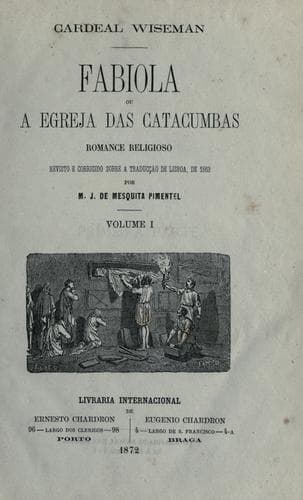
Fabiola; Or, The Church of the CatacombsWiseman, Nicholas Patrick
HistoryHistory
Fabiola; Or, The Church of the Catacombs
Wiseman, Nicholas Patrick
Christian fiction; Church history -- Primitive and early church, ca. 30-600 -- Fiction; Historical fiction
When Nicostratus informed him, as prefect of Rome, of the release of his
prisoners, and of the recovery of Tranquillinus from gout by baptism,
Chromatius, after making every inquiry into the truth of the fact, sent
for Sebastian, and proposed to become a Christian, as a means of
obtaining a cure of the same complaint. This of course could not be; and
another course was proposed, which would give him new and personal
evidence of Christianity, without risking an insincere baptism.
Chromatius was celebrated for the immense number of idolatrous images
which he possessed; and was assured by Sebastian that, if he would have
them all broken in pieces, he would at once recover. This was a hard
condition, but he consented. His son Tiburtius, however, was furious,
and protested that if the promised result did not follow, he would have
Sebastian and Polycarp thrown into a blazing furnace: not perhaps so
difficult a matter for the prefect’s son.
In one day two hundred pagan statues were broken in pieces, including,
of course, those in the villa, as well as those in the house at Rome.
The images indeed were broken; but Chromatius was not cured. Sebastian
was sent for and sharply rebuked. But he was calm and inflexible. “I am
sure,” he said, “that _all_ have not been destroyed. Something has been
withheld from demolition.” He proved right. Some small objects had been
treated as works of art rather than religious things, and, like Achan’s
coveted spoil,[66] concealed. They were brought forth and broken up; and
Chromatius instantly recovered. Not only was he converted, but his son
Tiburtius became also one of the most fervent of Christians; and, dying
in glorious martyrdom, gave his name to a catacomb. He had begged to
stay in Rome, to encourage and assist his fellow-believers, in the
coming persecution, which his connection with the palace, his great
courage and activity, would enable him to do. He had become, naturally,
the great friend and frequent companion of Sebastian and Pancratius.
After this little digression, we resume the conversation between
Chromatius and Fabiola, who continued her last sentence by adding:
“But do you know, Chromatius--let us sit down in this lovely spot, where
I remember there was a beautiful Bacchus--that all sorts of strange
reports are going round the country, about your doings here?”
“Dear me! What are they? Do tell me.”
“Why, that you have a quantity of people living with you whom nobody
knows; that you see no company, go out nowhere, and lead quite a
philosophical sort of life, forming a most Platonic republic.”
“Highly flattered!” interrupted Chromatius, with a smile and bow.
“But that is not all,” continued Fabiola. “They say you keep most
unfashionable hours, have no amusements, and live most abstemiously; in
fact, almost starve yourselves.”
Public-domain text, read in full here on John Shaqi.
Reviews
Reviews
No reviews yet
Be the first to share your thoughts on this work.
Elsewhere in the archive
Join the Discussion
Join the discussion
Sign in to leave a comment or review.
Sign InorCreate an account