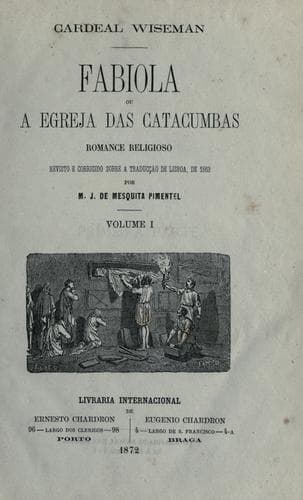
Fabiola; Or, The Church of the CatacombsWiseman, Nicholas Patrick
HistoryHistory
Fabiola; Or, The Church of the Catacombs
Wiseman, Nicholas Patrick
Christian fiction; Church history -- Primitive and early church, ca. 30-600 -- Fiction; Historical fiction
“But I hope they do us the justice to add, that we pay our way?”
observed Chromatius. “They don’t say, do they, that we have a long score
run up at the baker’s or grocer’s?”
“Oh, no!” replied Fabiola, laughing.
“How kind of them!” rejoined the good-humored old judge. “They--the
whole public I mean--seem to take a wonderful interest in our concerns.
But is it not strange, my dear young lady, that so long as my villa was
on the free-and-easy system, with as much loose talk, deep drinking,
occasional sallies of youthful mirth, and troublesome freaks in the
neighborhood, as others,--I beg your pardon for alluding to such things;
but, in fact, so long as I and my friends were neither temperate nor
irreproachable, nobody gave himself the least trouble about us? But let
a few people retire to live in quiet, be frugal, industrious, entirely
removed from public affairs, and never even talk about politics or
society, and at once there springs up a vulgar curiosity to know all
about them, and a mean _pruritus_ in third-rate statesmen to meddle with
them; and there must needs fly about flocks of false reports and foul
suspicions about their motives and manner of living. Is not this a
phenomenon?”
“It is, indeed; but how do you account for it?”
“I can only do so by that faculty of little minds which makes them
always jealous of any aims higher than their own; so that, almost
unconsciously, they depreciate whatever they feel to be better than they
dare aspire to.”
“But what is really your object and your mode of life here, my good
friend?”
“We spend our time in the cultivation of our higher faculties. We rise
frightfully early--I hardly dare tell you how early; we then devote some
hours to religious worship; after which we occupy ourselves in a variety
of ways; some read, some write, some labor in the gardens; and I assure
you no hired workmen ever toiled harder and better than these
spontaneous agriculturists. We meet at different times, and sing
beautiful songs together, all breathing virtue and purity, and read most
improving books, and receive oral instruction from eloquent teachers.
Our meals are indeed very temperate; we live entirely on vegetables;
but I have already found out that laughing is quite compatible with
lentils, and that good cheer does not necessarily mean good fare.”
“Why, you are turned complete Pythagoreans. I thought that was quite out
of date. But it must be a most economical system,” remarked Fabiola,
with a knowing look.
“Ha! you cunning thing!” answered the judge; “so you really think that
this may be a saving plan after all? But it won’t be, for we have taken
a most desperate resolution.”
“And what on earth is that?” asked the young lady.
“Nothing less than this. We are determined that there shall not be such
a thing as a poor person within our reach; this winter we will endeavor
to clothe all the naked, and feed the hungry, and attend to all the sick
about. All our economy will go for this.”
Public-domain text, read in full here on John Shaqi.
Reviews
Reviews
No reviews yet
Be the first to share your thoughts on this work.
Elsewhere in the archive
Join the Discussion
Join the discussion
Sign in to leave a comment or review.
Sign InorCreate an account