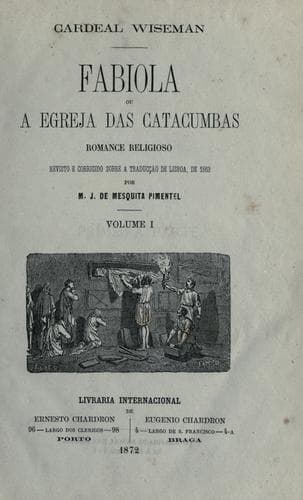
Fabiola; Or, The Church of the CatacombsWiseman, Nicholas Patrick
HistoryHistory
Fabiola; Or, The Church of the Catacombs
Wiseman, Nicholas Patrick
Christian fiction; Church history -- Primitive and early church, ca. 30-600 -- Fiction; Historical fiction
“It is indeed a very generous, though very new, idea in our times; and
no doubt you will be well laughed at for your pains, and abused on all
sides. They will even say worse of you than they do now, if it were
possible; but it is not.”
“How so?”
“Do not be offended if I tell you; but already they have gone so far as
to hint, that possibly you are Christians. But this, I assure you, I
have every where indignantly contradicted.”
Chromatius smiled, and said: “Why an _indignant_ contradiction, my dear
child?”
“Because, to be sure, I know you and Tiburtius, and Nicostratus, and
that dear dumb Zoë, too well to admit, for a moment, that you had
adopted the compound of stupidity and knavery called by that name.”
“Let me ask you one question. Have you taken the trouble of reading any
Christian writings, by which you might know what is really held and done
by that despised body?”
“Oh, not I indeed; I would not waste my time over them; I could not have
patience to learn any thing about them. I scorn them too much, as
enemies of all intellectual progress, as doubtful citizens, as credulous
to the last degree, and as sanctioning every abominable crime, ever to
give myself a chance of a nearer acquaintance with them.”
“Well, dear Fabiola, I thought just the same about them once, but I have
much altered my opinion of late.”
“This is indeed strange; since, as prefect of the city, you must have
had to punish many of these wretched people, for their constant
transgression of the laws.”
A cloud came over the cheerful countenance of the old man, and a tear
stood in his eye. He thought of St. Paul, who had once persecuted the
Church of God. Fabiola saw the change, and was distressed. In the most
affectionate manner she said to him, “I have said something very
thoughtless, I fear, or stirred up recollections of what must be painful
to your kind heart. Forgive me, dear Chromatius, and let us talk of
something else. One purpose of my visit to you was, to ask you if you
knew of any one going immediately to Rome. I have heard, from several
quarters, of my father’s projected journey, and I am anxious to write to
him,[67] lest he repeat what he did before,--go without taking leave of
me, to spare me pain.”
“Yes,” replied Chromatius, “there is a young man starting early
to-morrow morning. Come into the library, and write your letter; the
bearer is probably there.”
They returned to the house, and entered an apartment on the
ground-floor, full of book-chests. At a table in the middle of the room
a young man was seated, transcribing a large volume; which, on seeing a
stranger enter, he closed and put aside.
“Torquatus,” said Chromatius, addressing him, “this lady desires to send
a letter to her father in Rome.”
“It will always give me great pleasure,” replied the young man, “to
serve the noble Fabiola, or her illustrious father.”
“What, do you know them?” asked the judge, rather surprised.
Public-domain text, read in full here on John Shaqi.
Reviews
Reviews
No reviews yet
Be the first to share your thoughts on this work.
Elsewhere in the archive
Join the Discussion
Join the discussion
Sign in to leave a comment or review.
Sign InorCreate an account