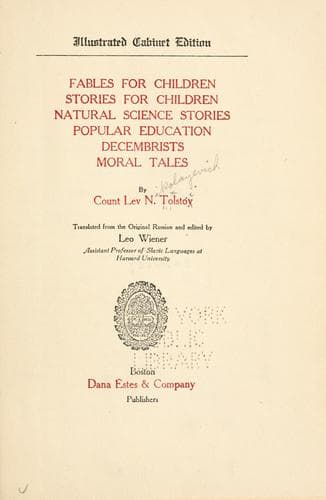
Fables for Children, Stories for Children, Natural Science Stories, Popular Education, Decembrists, Moral TalesTolstoy, Leo, graf
General
Fables for Children, Stories for Children, Natural Science Stories, Popular Education, Decembrists, Moral Tales
Tolstoy, Leo, graf
Russian literature -- Translations into English
"(3) Decomposition in order. It may easily happen that the children will
at once point out the decomposition of the number into component parts
in order; even then the third exercise cannot be regarded as
superfluous: Here we have formed four cubes of twos, of separate cubes,
and of threes,--in what order had we best place the cubes on the board?
With what shall the decomposition of the four cubes begin? With the
decomposition into separate cubes. How are four cubes to be formed from
separate cubes? We must take four times one cube. How are four cubes to
be formed from twos, from a pair? We must take two twos,--twice two
cubes, two pairs of cubes. How shall we afterward break up the four
cubes? They can be formed of threes: for this purpose we take three and
one, or one and three. The teacher explains to the pupils that the last
decomposition, that is, 1 1 2, does not come under the accepted order,
and is a modification of one of the first three."
Why does Mr. Evtushévski not admit this last decomposition? Why must
there be the order indicated by him? All that is a matter of mere
arbitrariness and fancy. In reality, it is apparent to every thinking
man that there is only one foundation for any composition and
decomposition, and for the whole of mathematics. Here is the
foundation: 1 + 1 = 2, 2 + 1 = 3, 3 + 1 = 4, and so forth,--precisely
what the children learn at home, and what in common parlance is called
counting to ten, to twenty, and so forth. This process is known to every
pupil, and no matter what decomposition Mr. Evtushévski may make, it is
to be explained from this one. A boy that can count to four, considers
four as a whole, and so also three, and two, and one. Consequently, he
knows that four was produced from the consecutive addition of one.
Similarly he knows that four is produced by adding twice one to two,
just as he knows twice one is two. What, then, are the children taught
here? That which they know, or that process of counting which they must
learn according to the teacher's fancy.
The other day I happened to witness a lesson in mathematics according to
Grube's method. The pupil was asked: "How much is 8 and 7?" He hastened
to answer and said 16. His neighbour, too, was in a hurry and, without
raising his left hand, said: "8 and 8 is 16, and one less is 15." The
teacher sternly stopped him, and compelled the first boy to add one
after one to 8, until he came to 15, though the boy knew long ago that
he had made a blunder. In that school they had reached the number 15,
but 16 was supposed to be unknown yet.
I am afraid that many people, reading all these long refutals of the
methods of object instruction and counting according to Grube, which I
am making, will say: "What is there here to talk about? Is it not
evident that it is all mere nonsense which it is not worth while to
criticize? Why pick out the errors and blunders of a Bunákov and
Evtushévski, and criticize what is beneath all criticism?"
Public-domain text, read in full here on John Shaqi.
Reviews
Reviews
No reviews yet
Be the first to share your thoughts on this work.
Elsewhere in the archive
Join the Discussion
Join the discussion
Sign in to leave a comment or review.
Sign InorCreate an account