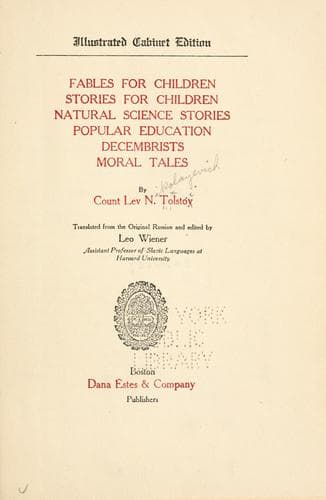
Fables for Children, Stories for Children, Natural Science Stories, Popular Education, Decembrists, Moral TalesTolstoy, Leo, graf
General
Fables for Children, Stories for Children, Natural Science Stories, Popular Education, Decembrists, Moral Tales
Tolstoy, Leo, graf
Russian literature -- Translations into English
That was the way I myself thought before I was led to see what was going
on in the pedagogical world, when I convinced myself that Messrs.
Bunákov and Evtushévski were not mere individuals, but authorities in
our pedagogics, and that what they prescribe is actually carried out in
our schools. In the backwoods we may find teachers, especially women,
who spread Evtushévski's and Bunákov's manuals out before them and ask
according to their prescription how much one feather and one feather is,
and what a hen is covered with. All that would be funny if it were only
an invention of the theorist, and not a guide in practical work, a guide
that some follow already, and if it did not concern one of the most
important affairs of life,--the education of the children. I was amused
at it when I read it as theoretical fancies; but when I learned and saw
that that was being practised on children, I felt pity for them and
ashamed.
From a theoretical standpoint, not to mention the fact that they
faultily define the aim of education, the pedagogues of this school make
this essential error, that they depart from the conditions of all
instruction, whether this instruction be on the highest or lowest stage
of the science, in a university or in a popular school. The essential
conditions of all instruction consist in selecting the homogeneous
phenomena from an endless number of heterogeneous phenomena, and in
imparting the laws of these phenomena to the students. Thus, in the
study of language, the pupils are taught the laws of the word, and in
mathematics, the laws of the numbers. The study of language consists in
imparting the laws of the decomposition and of the reverse composition
of sentences, words, syllables, sounds,--and these laws form the subject
of instruction. The instruction of mathematics consists in imparting the
laws of the composition and decomposition of the numbers (but I beg to
observe,--not in the process of the composition and the decomposition of
the numbers, but in imparting the laws of that composition and
decomposition). Thus, the first law consists in the ability of regarding
a collection of units as a unit of a higher order, precisely what a
child does when he says: "2 and 1 = 3." He regards 2 as a kind of unit.
On this law are based the consequent laws of numeration, then of
addition, and of the whole of mathematics. But arbitrary conversations
about the wasp, and so forth, or problems within the limit of 10,--its
decomposition in every manner possible,--cannot form a subject of
instruction, because, in the first place, they transcend the subject
and, in the second place, because they do not treat of its laws.
Public-domain text, read in full here on John Shaqi.
Reviews
Reviews
No reviews yet
Be the first to share your thoughts on this work.
Elsewhere in the archive
Join the Discussion
Join the discussion
Sign in to leave a comment or review.
Sign InorCreate an account