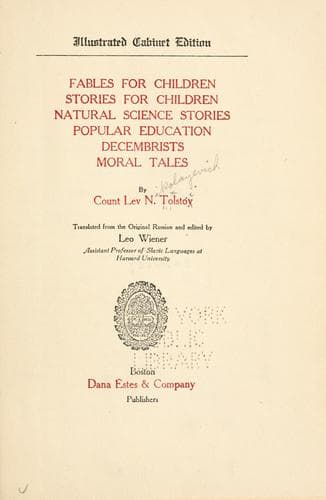
Fables for Children, Stories for Children, Natural Science Stories, Popular Education, Decembrists, Moral TalesTolstoy, Leo, graf
General
Fables for Children, Stories for Children, Natural Science Stories, Popular Education, Decembrists, Moral Tales
Tolstoy, Leo, graf
Russian literature -- Translations into English
That is the way the matter presents itself to me from its theoretical
side; but theoretical criticism may frequently err, and so I will try to
verify my deductions by means of practical data. G---- P---- has given
us a sample of the practical results of both object instruction and of
mathematics according to Grube's method. One of the older boys was told:
"Put your hand under your book!" in order to prove that he had been
taught the conceptions of "over" and "under," and the intelligent boy,
who, I am sure, knew what "over" and "under" was, when he was three
years old, put his hand on the book when he was told to put it under it.
I have all the time observed such examples, and they prove more clearly
than anything else how useless, strange, and disgraceful, I feel like
saying, this object instruction is for Russian children. A Russian child
cannot and will not believe (he has too much respect for the teacher and
for himself) that the teacher is in earnest when he asks him whether the
ceiling is above or below, or how many legs he has. In arithmetic, too,
we have seen that pupils who did not even know how to write the numbers
and during the whole time of the instruction were exercised only in
mental calculations up to 10, for half an hour did not stop blundering
in every imaginable way in response to questions which the teacher put
to them within the limit of 10. Evidently the instruction of mental
calculation brought no results, and the syntactical difficulty, which
consists in unravelling a question that is improperly put, has remained
the same as ever. And thus, the practical results of the examination
which took place did not confirm the usefulness of the development.
But I will be more exact and conscientious. Maybe the process of
development, which at first is confined not so much to the study, as to
the analysis of what the pupils know already, will produce results later
on. Maybe the teacher, who at first takes possession of the pupils'
minds by means of the analysis, later guides them firmly and with ease,
and from the narrow sphere of the descriptions of a table and the count
of 2 and 1 leads them into the real sphere of knowledge, in which the
pupils are no longer confined to learning what they know already, but
also learn something new, and learn that new information in a new, more
convenient, more intelligent manner. This supposition is confirmed by
the fact that all the German pedagogues and their followers, among them
Mr. Bunákov, say distinctly that object instruction is to serve as an
introduction to "home science" and "natural science." But we should be
looking in vain in Mr. Bunákov's manual to find out how this "home
science" is to be taught, if by this word any real information is to be
understood, and not the descriptions of a hut and a vestibule,--which
the children know already. Mr. Bunákov, on page 200, after having
explained that it is necessary to teach where the ceiling is and where
the stove, says briefly:
Public-domain text, read in full here on John Shaqi.
Reviews
Reviews
No reviews yet
Be the first to share your thoughts on this work.
Elsewhere in the archive
Join the Discussion
Join the discussion
Sign in to leave a comment or review.
Sign InorCreate an account