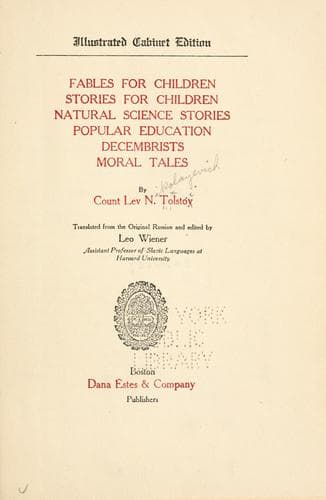
Fables for Children, Stories for Children, Natural Science Stories, Popular Education, Decembrists, Moral TalesTolstoy, Leo, graf
General
Fables for Children, Stories for Children, Natural Science Stories, Popular Education, Decembrists, Moral Tales
Tolstoy, Leo, graf
Russian literature -- Translations into English
"Now it is necessary to pass over to the third stage of object
instruction, the contents of which have been defined by me as follows:
The study of the country, county, Government, the whole realm with its
natural products and its inhabitants, in general outline, as a sketch of
home science and the beginning of natural science, with the predominance
of reading, which, resting on the immediate observations of the first
two grades, broadens the mental horizon of the pupils,--the sphere of
their concepts and ideas. We can see from the mere definition that here
the objectivity appears as a complement to the explanatory reading and
narrative of the teacher,--consequently, what is said in regard to the
occupations of the third year has more reference to the discussion of
the second occupation, which enters into the composition of the subject
under instruction, which is called the native language,--the explanatory
reading."
We turn to the third year,--the explanatory reading, but there we find
absolutely nothing to indicate how the new information is to be
imparted, except that it is good to read such and such books, and in
reading to put such and such questions. The questions are extremely
queer (to me, at least), as, for example, the comparison of the article
on water by Ushínski and of the article on water by Aksákov, and the
request made of the pupils that they should explain that Aksákov
considers water as a phenomenon of Nature, while Ushínski considers it
as a substance, and so forth. Consequently, we find here again the same
foisting of views on the pupils, and of subdivisions (generally
incorrect) of the teacher, and not one word, not one hint, as to how any
new knowledge is to be imparted.
It is not known what shall be taught: natural history, or geography.
There is nothing there but reading with questions of the character I
have just mentioned. On the other side of the instruction about the
word,--grammar and orthography,--we should just as much be looking in
vain for any new method of instruction which is based on the preceding
development. Again the old Perevlévski's grammar, which begins with
philosophical definitions and then with syntactical analysis, serves as
the basis of all new grammatical exercises and of Mr. Bunákov's manual.
In mathematics, too, we should be looking in vain, at that stage where
the real instruction in mathematics begins, for anything new and more
easy, based on the whole previous instruction of the exercises of the
second year up to 20. Where in arithmetic the real difficulties are met
with, where it becomes necessary to explain the subject from all its
sides to the pupil, as in numeration, in addition, subtraction,
division, in the division and multiplication of fractions, you will not
find even a shadow of anything easier, any new explanation, but only
quotations from old arithmetics.
Public-domain text, read in full here on John Shaqi.
Reviews
Reviews
No reviews yet
Be the first to share your thoughts on this work.
Elsewhere in the archive
Join the Discussion
Join the discussion
Sign in to leave a comment or review.
Sign InorCreate an account