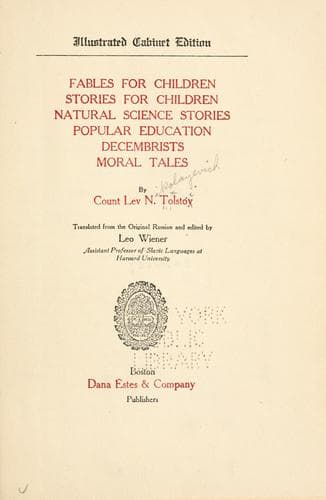
Fables for Children, Stories for Children, Natural Science Stories, Popular Education, Decembrists, Moral TalesTolstoy, Leo, graf
General
Fables for Children, Stories for Children, Natural Science Stories, Popular Education, Decembrists, Moral Tales
Tolstoy, Leo, graf
Russian literature -- Translations into English
"According to my opinion, the evil does not come from hunger, but from
love. If we lived singly, the trouble would not be so bad. One head is
not poor, and if it is, it is only one. But here we live in pairs. And
you come to like your mate so much that you have no rest: you keep
thinking of her all the time, wondering whether she has had enough to
eat, and whether she is warm. And when your mate flies away from you,
you feel entirely lost, and you keep thinking that a hawk may have
carried her off, or men may have caught her; and you start out to find
her, and fly to your ruin,--either into the hawk's claws, or into a
snare. And when your mate is lost, nothing gives you any joy. You do not
eat or drink, and all the time search and weep. Oh, so many of us perish
in this way! All the evil is not from hunger, but from love."
The Snake said:
"No, the evil is not from hunger, nor from love, but from rage. If we
lived peacefully, without getting into a rage, everything would be nice
for us. But, as it is, whenever a thing does not go exactly right, we
get angry, and then nothing pleases us. All we think about is how to
revenge ourselves on some one. Then we forget ourselves, and only hiss,
and creep, and try to find some one to bite. And we do not spare a
soul,--we even bite our own father and mother. We feel as though we
could eat ourselves up. And we rage until we perish. All the evil in the
World comes from rage."
The Stag said:
"No, not from rage, or from love, or from hunger does all the evil in
the world come, but from terror. If it were possible not to be afraid,
everything would be well. We have swift feet and much strength: against
a small animal we defend ourselves with our horns, and from a large one
we flee. But how can I help becoming frightened? Let a branch crackle in
the forest, or a leaf rustle, and I am all atremble with fear, and my
heart flutters as though it wanted to jump out, and I fly as fast as I
can. Again, let a hare run by, or a bird flap its wings, or a dry twig
break off, and you think that it is a beast, and you run straight up
against him. Or you run away from a dog and run into the hands of a man.
Frequently you get frightened and run, not knowing whither, and at full
speed rush down a steep hill, and get killed. We have no rest. All the
evil comes from terror."
Then the Hermit said:
"Not from hunger, not from love, not from rage, not from terror are all
our sufferings, but from our bodies comes all the evil in the world.
From them come hunger, and love, and rage, and terror."
THE WOLF AND THE HUNTERS
A Wolf devoured a sheep. The Hunters caught the Wolf and began to beat
him. The Wolf said:
"In vain do you beat me: it is not my fault that I am gray,--God has
made me so."
But the Hunters said:
"We do not beat the Wolf for being gray, but for eating the sheep."
THE TWO PEASANTS
Once upon a time two Peasants drove toward each other and caught in each
other's sleighs. One cried:
Public-domain text, read in full here on John Shaqi.
Reviews
Reviews
No reviews yet
Be the first to share your thoughts on this work.
Join the Discussion
Join the discussion
Sign in to leave a comment or review.
Sign InorCreate an account