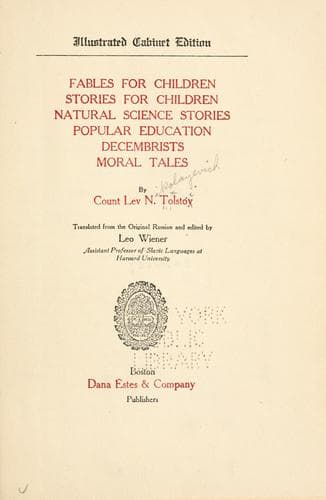
Fables for Children, Stories for Children, Natural Science Stories, Popular Education, Decembrists, Moral TalesTolstoy, Leo, graf
General
Fables for Children, Stories for Children, Natural Science Stories, Popular Education, Decembrists, Moral Tales
Tolstoy, Leo, graf
Russian literature -- Translations into English
Pedagogy is in the same condition in which a science would be that would
teach how a man ought to walk; and people would try to discover rules
about how to teach the children, how to enjoin them to contract this
muscle, stretch that muscle, and so forth. This condition of the new
pedagogy results directly from its two fundamental principles: (1) that
the aim of the school is development and not science, and (2) that
development and the means for attaining it may be theoretically defined.
From this has consistently resulted that miserable and frequently
ridiculous condition in which the whole matter of the schools now is.
Forces are wasted in vain, and the masses, who at the present moment are
thirsting for education, as the dried-up grass thirsts for rain, and are
ready to receive it, and beg for it,--instead of a loaf receive a stone,
and are perplexed to understand whether they were mistaken in regarding
education as something good, or whether something is wrong in what is
being offered to them. That matters are really so there cannot be the
least doubt for any man who becomes acquainted with the present theory
of teaching and knows the actual condition of the school among the
masses. Involuntarily there arises the question: how could honest,
cultured people, who sincerely love their work and wish to do good,--for
such I regard the majority of my opponents to be,--have arrived at such
a strange condition and be in such deep error?
This question has interested me, and I will try to communicate those
answers which have occurred to me. Many causes have led to it. The most
natural cause which has led pedagogy to the false path on which it now
stands, is the criticism of the old order, the criticism for the sake of
criticism, without positing new principles in the place of those
criticized. Everybody knows that criticizing is an easy business, and
that it is quite fruitless and frequently harmful, if by the side of
what is condemned one does not point out the principles on the basis of
which this condemnation is uttered. If I say that such and such a thing
is bad because I do not like it, or because everybody says that it is
bad, or even because it is really bad, but do not know how it ought to
be right, the criticism will always be useless and injurious. The views
of the pedagogues of the new school are, above all, based on the
criticism of previous methods. Even now, when it seems there would be no
sense in striking a prostrate person, we read and hear in every manual,
in every discussion, "that it is injurious to read without
comprehension; that it is impossible to learn by heart the definitions
of numbers and operations with numbers; that senseless memorizing is
injurious; that it is injurious to operate with thousands without being
able to count 2-3," and so forth. The chief point of departure is the
criticism of the old methods and the concoction of new ones to be as
diametrically opposed to the old as possible, but by no means the
Public-domain text, read in full here on John Shaqi.
Reviews
Reviews
No reviews yet
Be the first to share your thoughts on this work.
Elsewhere in the archive
Join the Discussion
Join the discussion
Sign in to leave a comment or review.
Sign InorCreate an account