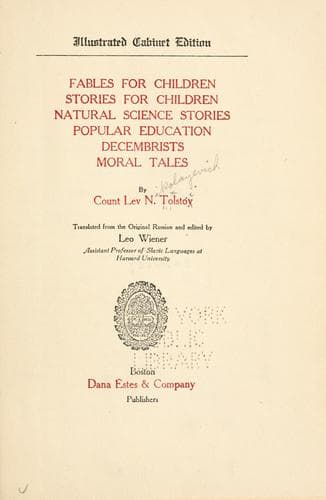
Fables for Children, Stories for Children, Natural Science Stories, Popular Education, Decembrists, Moral TalesTolstoy, Leo, graf
General
Fables for Children, Stories for Children, Natural Science Stories, Popular Education, Decembrists, Moral Tales
Tolstoy, Leo, graf
Russian literature -- Translations into English
positing of new foundations of pedagogy, from which new methods might
result.
It is very easy to criticize the old-fashioned method of studying
reading by means of learning by heart whole pages of the psalter, and of
studying arithmetic by memorizing what a number is, and so forth. I will
remark, in the first place, that nowadays there is no need of attacking
these methods, because there will hardly be found any teachers who would
defend them, and, in the second place, that if, criticizing such
phenomena, they want to let it be known that I am a defender of the
antiquated method of instruction, it is no doubt due to the fact that my
opponents, in their youth, do not know that nearly twenty years ago I
with all my might and main fought against those antiquated methods of
pedagogy and coöperated in their abolition.
And thus it was found that the old methods of instruction were not good
for anything, and, without building any new foundation, they began to
look for new methods. I say "without building any new foundation,"
because there are only two permanent foundations of pedagogy:
(1) The determination of the criterion of what ought to be taught, and
(2) the criterion of how it has to be taught, that is, the determination
that the chosen subjects are most necessary, and that the chosen method
is the best.
Nobody has even paid any attention to these foundations, and each school
has in its own justification invented quasi-philosophical justificatory
reflections. But this "theoretical substratum," as Mr. Bunákov has
accidentally expressed himself quite well, cannot be regarded as a
foundation. For the old method of instruction possessed just such a
theoretical substratum.
The real, peremptory question of pedagogy, which fifteen years ago I
vainly tried to put in all its significance, "Why ought we to know this
or that, and how shall we teach it?" has not even been touched. The
result of this has been that as soon as it became apparent that the old
method was not good, they did not try to find out what the best method
would be, but immediately set out to discover a new method which would
be the very opposite of the old one. They did as a man may do who finds
his house to be cold in winter and does not trouble himself about
learning why it is cold, or how to help matters, but at once tries to
find another house which will as little as possible resemble the one he
is living in. I was then abroad, and I remember how I everywhere came
across messengers roving all over Europe in search of a new faith, that
is, officials of the ministry, studying German pedagogy.
Public-domain text, read in full here on John Shaqi.
Reviews
Reviews
No reviews yet
Be the first to share your thoughts on this work.
Elsewhere in the archive
Join the Discussion
Join the discussion
Sign in to leave a comment or review.
Sign InorCreate an account