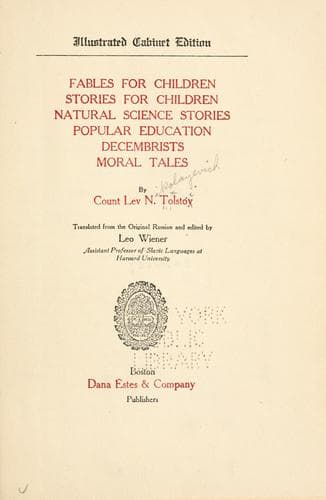
Fables for Children, Stories for Children, Natural Science Stories, Popular Education, Decembrists, Moral TalesTolstoy, Leo, graf
General
Fables for Children, Stories for Children, Natural Science Stories, Popular Education, Decembrists, Moral Tales
Tolstoy, Leo, graf
Russian literature -- Translations into English
We have adopted the methods of instruction current with our nearest
neighbours, the Germans, in the first place, because we are always
prone to imitate the Germans; in the second, because it was the most
complicated and cunning of methods, and if it comes to taking something
from abroad, of course, it has to be the latest fashion and what is most
cunning; in the third, because, in particular, these methods were more
than any others opposed to the old way. And thus, the new methods were
taken from the Germans, and not by themselves, but with a theoretical
substratum, that is, with a quasi-philosophical justification of these
methods.
This theoretical substratum has done great service. The moment parents
or simply sensible people, who busy themselves with the question of
education, express their doubt about the efficacy of these methods, they
are told: "And what about Pestalozzi, and Diesterweg, and Denzel, and
Wurst, and methodics, heuristics, didactics, concentrism?" and the bold
people wave their hands, and say: "God be with them,--they know better."
In these German methods there also lay this other advantage (the cause
why they stick so eagerly to this method), that with it the teacher does
not need to try too much, does not need to go on studying, does not need
to work over himself and the methods of instruction. For the greater
part of the time the teacher teaches by this method what the children
know, and, besides, teaches it from a text-book, and that is convenient.
And unconsciously, in accordance with an innate human weakness, the
teacher is fond of this convenience. It is very pleasant for me, with my
firm conviction that I am teaching and doing an important and very
modern work, to tell the children from the book about the suslik, or
about a horse's having four legs, or to transpose the cubes by twos and
by threes, and ask the children how much two and two is; but if, instead
of telling about the suslik, the teacher had to tell or read something
interesting, to give the foundations of grammar, geography, sacred
history, and of the four operations, he would at once be led to working
over himself, to reading much, and to refreshing his knowledge.
Public-domain text, read in full here on John Shaqi.
Reviews
Reviews
No reviews yet
Be the first to share your thoughts on this work.
Elsewhere in the archive
Join the Discussion
Join the discussion
Sign in to leave a comment or review.
Sign InorCreate an account