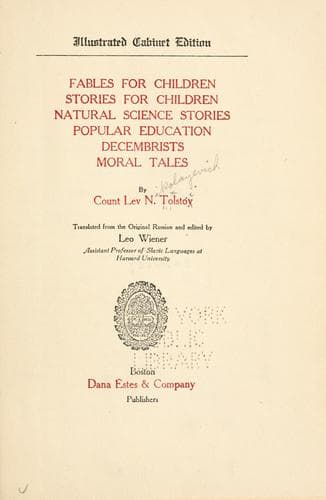
Fables for Children, Stories for Children, Natural Science Stories, Popular Education, Decembrists, Moral TalesTolstoy, Leo, graf
General
Fables for Children, Stories for Children, Natural Science Stories, Popular Education, Decembrists, Moral Tales
Tolstoy, Leo, graf
Russian literature -- Translations into English
Formerly syllables were senselessly learned by heart (that was bad);
diametrically opposed to this, the new fashion enjoins us not to divide
up into syllables at all, which is absolutely impossible in a long word,
and which in reality is never done. Every teacher, according to the
sound method, feels the necessity of letting a pupil rest after a part
of a word, having him pronounce it separately. Formerly they used to
read the psalter, which, on account of its high and deep style, is
incomprehensible to the children (which was bad); in contrast to this
the children are made to read sentences without any contents whatever,
to explain intelligible words, or to learn by heart what they cannot
understand. In the old school the teacher did not speak to the pupil at
all; now the teacher is ordered to talk to them on anything and
everything, on what they know already, or what they do not need to know.
In mathematics they formerly learned by heart the definition of
operations, but now they no longer have anything to do with operations,
for, according to Evtushévski, they reach numeration only in the third
year, and it is assumed that for a whole year they are to be taught
nothing but numbers up to ten. Formerly the pupils were made to work
with large abstract numbers, without paying any attention to the other
side of mathematics, to the disentanglement of the problem (the
formation of an equation). Now they are taught solving puzzles, forming
equations with small numbers before they know numeration and how to
operate with numbers, though experience teaches any teacher that the
difficulty of forming equations or the solution of puzzles are overcome
by a general development in life, and not in school.
It has been observed--quite correctly--that there is no greater aid for
a pupil, when he is puzzled by a problem with large numbers, than to
give him the same problem with smaller numbers. The pupil, who in life
learns to grope through problems with small numbers, is conscious of the
process of solving, and transfers this process to the problem with large
numbers. Having observed this, the new pedagogues try to teach only the
solving of puzzles with small numbers, that is, what cannot form the
subject of instruction and is only the work of life.
Public-domain text, read in full here on John Shaqi.
Reviews
Reviews
No reviews yet
Be the first to share your thoughts on this work.
Elsewhere in the archive
Join the Discussion
Join the discussion
Sign in to leave a comment or review.
Sign InorCreate an account