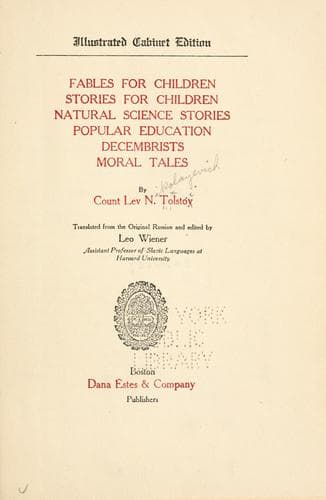
Fables for Children, Stories for Children, Natural Science Stories, Popular Education, Decembrists, Moral TalesTolstoy, Leo, graf
General
Fables for Children, Stories for Children, Natural Science Stories, Popular Education, Decembrists, Moral Tales
Tolstoy, Leo, graf
Russian literature -- Translations into English
In the instruction of grammar the new school has again remained
consistent with its point of departure,--with the criticism of the old
and the adoption of the diametrically opposite method. Formerly they
used to learn by heart the definition of the parts of speech, and from
etymology passed over to syntax; now they not only begin with syntax,
but even with logic, which the children are supposed to acquire.
According to the grammar of Mr. Bunákov, which is an abbreviation of
Perevlévski's grammar, even with the same choice of examples, the study
of grammar begins with syntactical analysis, which is so difficult and,
I will say, so uncertain for the Russian language, which does not fully
comply with the classic forms of syntax. To sum up, the new school has
removed certain disadvantages, of which the chief are the superfluous
addition to the consonants and the memorizing of definitions, and in
this it is superior to the old method, and in reading and writing
sometimes gives better results; but, on the other hand, it has
introduced new defects, which are that the contents of the reading are
most senseless and that arithmetic is no longer taught as a study.
In practice (I can refer in this to all the inspectors of schools, to
all the members of school councils, who have visited the schools, and to
all the teachers), in practice, in the majority of schools, where the
German method is prescribed, this is what takes place, with rare
exceptions. The children learn not by the sound system, but by the
method of letter composition; instead of saying _b_, _v_, they say
_b[)u]_, _v[)u]_, and break up the words into syllables. The object
instruction is entirely lost sight of, arithmetic does not proceed at
all, and the children have absolutely nothing to read. The teachers
quite unconsciously depart from the theoretical demands and fall in with
the needs of the masses. These practical results, which are repeated
everywhere, should, it seems, prove the incorrectness of the method
itself; but among the pedagogues, those that write manuals and prescribe
rules, there exists such a complete ignorance of and aversion to the
knowledge of the masses and their demands that the relation of reality
to these methods does not in the least impair the progress of their
business. It is hard to imagine the conception about the masses which
exists in this world of the pedagogues, and from which result their
method and all the consequent manner of instruction.
Public-domain text, read in full here on John Shaqi.
Reviews
Reviews
No reviews yet
Be the first to share your thoughts on this work.
Elsewhere in the archive
Join the Discussion
Join the discussion
Sign in to leave a comment or review.
Sign InorCreate an account