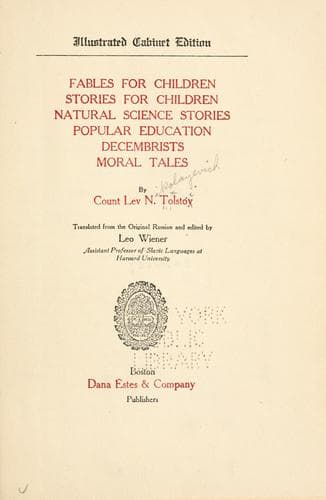
Fables for Children, Stories for Children, Natural Science Stories, Popular Education, Decembrists, Moral TalesTolstoy, Leo, graf
General
Fables for Children, Stories for Children, Natural Science Stories, Popular Education, Decembrists, Moral Tales
Tolstoy, Leo, graf
Russian literature -- Translations into English
Mr. Bunákov, in proof of how necessary the object instruction and
development is for the children of a Russian school, with extraordinary
naïveté adduces Pestalozzi's words: "Let any one who has lived among the
common people," he says, "contradict my words that there is nothing more
difficult than to impart any idea to these creatures. Nobody, indeed,
gainsays that. The Swiss pastors affirm that when the people come to
them to receive instruction they do not understand what they are told,
and the pastors do not understand what the people say to them. City
dwellers who settle in the country are amazed at the inability of the
country population to express themselves; years pass before the country
servants learn to express themselves to their masters." This relation of
the common people in Switzerland to the cultured class is assumed as the
foundation for just such a relation in Russia.
I regard it as superfluous to expatiate on what is known to everybody,
that in Germany the people speak a special language, called
Plattdeutsch, and that in the German part of Switzerland this
Plattdeutsch is especially far removed from the German language, whereas
in Russia we frequently speak a bad language, while the masses always
speak a good Russian, and that in Russia it will be more correct to put
these words of Pestalozzi in the mouth of peasants speaking of the
teachers. A peasant and his boy will say quite correctly that it is very
hard to understand what those creatures, meaning the teachers, say. The
ignorance about the masses is so complete in this world of the
pedagogues that they boldly say that to the peasant school come little
savages, and therefore boldly teach them what is down and what up, that
a blackboard is placed on a stand, and that underneath it there is a
groove. They do not know that if the pupils asked the teacher, there
would turn up very many things which the teacher would not know; that,
for example, if you rub off the paint from the board, nearly any boy
will tell you of what kind of wood the board is made, whether of pine,
linden, or aspen, which the teacher cannot tell; that a boy will always
tell better than the teacher about a cat or a chicken, because he has
observed them better than the teacher; that instead of the problem about
the wagons the boy knows the problems about the crows, about the cattle,
and about the geese. (About the crows: There flies a flock of crows, and
there stand some oak-trees: if two crows alight on each, a crow will be
lacking; if one on each, an oak-tree will be lacking. How many crows and
how many oak-trees are there? About the cattle: For one hundred roubles
buy one hundred animals,--calves at half a rouble, cows at three
roubles, and oxen at ten roubles. How many oxen, cows, and calves are
there?) The pedagogues of the German school do not even suspect that
quickness of perception, that real vital development, that contempt for
everything false, that ready ridicule of everything false, which are
Public-domain text, read in full here on John Shaqi.
Reviews
Reviews
No reviews yet
Be the first to share your thoughts on this work.
Elsewhere in the archive
Join the Discussion
Join the discussion
Sign in to leave a comment or review.
Sign InorCreate an account