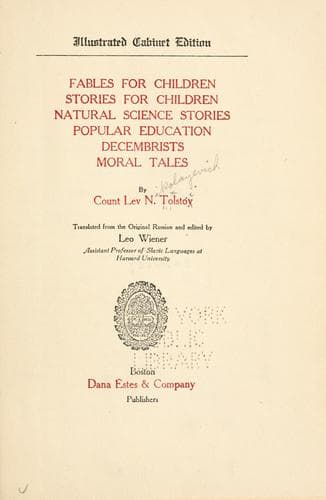
Fables for Children, Stories for Children, Natural Science Stories, Popular Education, Decembrists, Moral TalesTolstoy, Leo, graf
General
Fables for Children, Stories for Children, Natural Science Stories, Popular Education, Decembrists, Moral Tales
Tolstoy, Leo, graf
Russian literature -- Translations into English
inherent in every Russian peasant boy,--and only on that account so
boldly (as I myself have seen), under the fire of forty pairs of
intelligent youthful eyes, perform their tricks at the risk of ridicule.
For this reason, a real teacher, who knows the masses, no matter how
sternly he is enjoined to teach the peasant children what is up and what
down, and that two and three is five, not one real teacher, who knows
the pupils with whom he has to deal, will be able to do that.
Thus, the chief causes which have led us into such error are: (1) the
ignorance about the masses; (2) the involuntarily seductive ease of
teaching the children what they already know; (3) our proneness to
imitate the Germans, and (4) the criticism of the old, without putting
down a new, foundation. This last cause has led the pedagogues of the
new school to this, that, in spite of the extreme external difference of
the new method from the old, it is identical with it in its foundation,
and, consequently, in the methods of instruction and in the results. In
either method the essential principle consists in the teacher's firm and
absolute knowledge of what to teach and how to teach, and this knowledge
of his he does not draw from the demands of the masses and from
experience, but simply decides theoretically once for all that he must
teach this or that and in such a way, and so he teaches. The pedagogue
of the ancient school, which for briefness' sake I shall call the church
school, knows firmly and absolutely that he must teach from the
prayer-book and the psalter by making the children learn by rote, and he
admits no alterations in his methods; in the same manner the teacher of
the new, the German, school knows firmly and absolutely that he must
teach according to Bunákov and Evtushévski, begin with the words
"whisker" and "wasp," ask what is up and what down, and tell about the
favourite suslik, and he admits no alterations in his method. Both of
them base their opinion on the firm conviction that they know the best
methods. From the identity of the foundations arises also a further
similarity. If you tell a teacher of the church reading that it takes
the children a long time and causes them difficulty to acquire reading
and writing, he will reply that the main interest is not in the reading
and writing, but in the "divine instruction," by which he means the
study of the church books. The same you will be told by a teacher of
Russian reading according to the German method. He will tell you (all
say and write it) that the main question is not the rapidity of the
acquisition of the art of reading, writing, and arithmetic, but in the
"development." Both place the aim of instruction in something
independent of reading, writing, and arithmetic, that is, of science, in
something else, which is absolutely necessary.
Public-domain text, read in full here on John Shaqi.
Reviews
Reviews
No reviews yet
Be the first to share your thoughts on this work.
Elsewhere in the archive
Join the Discussion
Join the discussion
Sign in to leave a comment or review.
Sign InorCreate an account