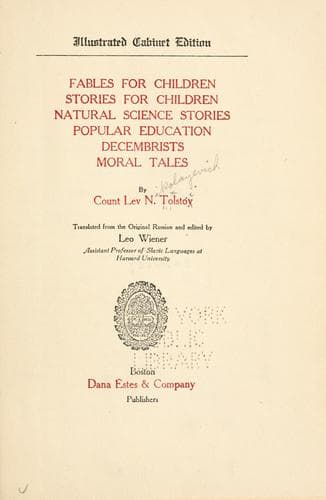
Fables for Children, Stories for Children, Natural Science Stories, Popular Education, Decembrists, Moral TalesTolstoy, Leo, graf
General
Fables for Children, Stories for Children, Natural Science Stories, Popular Education, Decembrists, Moral Tales
Tolstoy, Leo, graf
Russian literature -- Translations into English
roubles in silver, and the County Council has distributed Ushínski's
text-books, and these schools are called one-class schools, because they
teach in them according to a programme, and the whole year around, that
is, also in summer, with the exception of July and August.
Leaving aside the question of the quality of the former schools, we
shall now take a glance at their administrative side, and we will
compare, from this side, what was before, with what is now. In the
administrative, external side of the school there are five main
subjects, which are so closely connected with the school business itself
that on their good or bad structure depend to a great extent the success
and dissemination of popular education. These five subjects are: (1) the
school building, (2) the schedule of instruction, (3) the distribution
of the schools according to localities, (4) the choice of the teacher,
and--what is most important--(5) the material means, the remuneration of
the teachers.
In regard to the school building the masses rarely have any difficulty,
when they start a school for themselves, and if the Commune is rich and
there are any communal buildings, such as a storehouse or a deserted
inn, the Commune fixes it up; if there is none, it buys a building, at
times even from a landed proprietor, or it builds one of its own. If the
Commune is not well-to-do and is small, it hires quarters from a
peasant, or establishes a rotation, and the teacher passes from hut to
hut. If the Commune, as it most generally does, selects a teacher from
its own midst, a manorial servant, a soldier, or a church servant, the
school is located at the house of that person, and the Commune looks
only after the heating. In any case, I have never heard that the
question of the location of the school ever troubled a Commune, or that
half the sum set aside for instruction should be lost, as is done by
school councils, on the buildings, nay, not even one-sixth or one-tenth
of the whole sum. The peasant Communes have arranged it one way or
another, but the question of the school building has never been regarded
as troublesome. Only under the influence of the higher authorities do
there occur cases where the Communes build brick buildings with iron
roofs. The peasants assume that the school is not in the structure, but
in the teacher, and that the school is not a permanent institution, but
that as soon as the parents have acquired knowledge, the next generation
will get the rudiments without a teacher. But the County Council
department of the ministry always assumes--since for it the whole
problem consists in inspecting and classifying--that the chief
foundation of the school is the structure and that the school is a
permanent establishment, and so, as far as I know, now spends about
one-half of its money on buildings, and inscribes empty school buildings
in the list of the schools of the third order. In the Krapívensk County
Public-domain text, read in full here on John Shaqi.
Reviews
Reviews
No reviews yet
Be the first to share your thoughts on this work.
Elsewhere in the archive
Join the Discussion
Join the discussion
Sign in to leave a comment or review.
Sign InorCreate an account