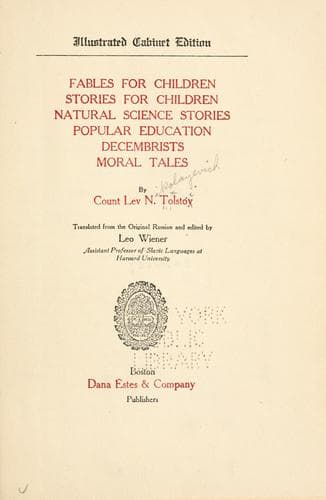
Fables for Children, Stories for Children, Natural Science Stories, Popular Education, Decembrists, Moral TalesTolstoy, Leo, graf
General
Fables for Children, Stories for Children, Natural Science Stories, Popular Education, Decembrists, Moral Tales
Tolstoy, Leo, graf
Russian literature -- Translations into English
Council seven hundred roubles out of two thousand roubles are spent on
buildings. The ministerial department cannot admit that the teacher
(that educated pedagogue who is assumed for the masses) would lower
himself to such an extent as to be willing to go, like a tailor, from
hut to hut, or to teach in a smoky house. But the masses assume nothing
and only know that for their money they can hire whom they please, and
that, if they, the hiring peasants, live in smoky huts, the hired
teacher has no reason to turn up his nose at them.
In regard to the second question, about the division of the school time,
the masses have always and everywhere invariably expressed one demand,
and that is that the instruction shall be carried on in the winter only.
Everywhere the parents quit sending their children in the spring, and
those children who are left in the school, from one-fourth to one-fifth
of the whole number, are the little tots or the children of rich
parents, and they attend school unwillingly. When the masses hire a
teacher themselves, they always hire him by the month and only for the
winter. The ministerial department assumes that, just as in the
institutions of learning there are two months of vacation, so it ought
also to be in a one-class country school. From the standpoint of the
ministerial department that is quite reasonable: the children will not
forget their instruction, the teacher is provided for during the whole
year, and the inspectors find it more comfortable to travel in the
summer; but the masses know nothing about all that, and their common
sense tells them that in winter the children sleep for ten hours,
consequently their minds are fresh; that in winter there are no plays
and no work for the children, and that if they study in winter as long
as possible, taking in even the evenings, for which a lamp costing one
rouble fifty kopeks is needed and kerosene costing as much, there will
be enough instruction. Besides, in the summer every boy is of use to
the peasant, and in summer proceeds the life instruction, which is more
important than school learning. The masses say that there is no reason
why they should pay the teacher during the summer. "Rather will we
increase his pay for the winter months, and that will please him better.
We prefer to hire a teacher at twenty-five roubles a month for seven
months, than at twelve roubles a month for the whole year. For the
summer the teacher will hire himself out elsewhere."
Public-domain text, read in full here on John Shaqi.
Reviews
Reviews
No reviews yet
Be the first to share your thoughts on this work.
Elsewhere in the archive
Join the Discussion
Join the discussion
Sign in to leave a comment or review.
Sign InorCreate an account