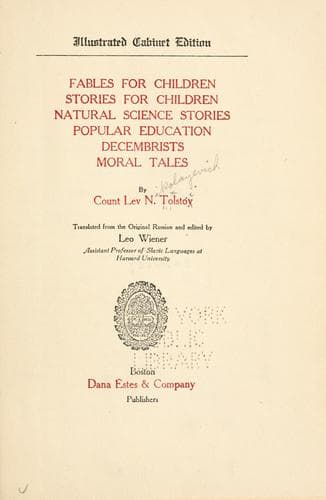
Fables for Children, Stories for Children, Natural Science Stories, Popular Education, Decembrists, Moral TalesTolstoy, Leo, graf
General
Fables for Children, Stories for Children, Natural Science Stories, Popular Education, Decembrists, Moral Tales
Tolstoy, Leo, graf
Russian literature -- Translations into English
As to the third question, the distribution of the schools according to
localities, the arrangements of the masses most markedly differ from
those of the school council. In the first place, the distribution of the
schools, that is, whether there shall be more or less of them for a
certain locality, always depends on the character of the whole
population (when the masses themselves attend to it). Wherever the
masses are more industrial and work out, where they are nearer to the
cities, where they need the rudiments,--there there are more schools;
where the locality is more removed and agricultural, there there are
fewer of them. In the second place, when the masses themselves attend to
the matter, they distribute the schools in such a way as to give all the
parents a chance to make use of the schools in return for their money,
that is, to send their children to school. The peasants of small, remote
villages of from thirty to forty souls, where half the population will
be found, prefer to have a cheap teacher in their own village, than an
expensive one in the centre of the township, whither their children
cannot walk or be driven. By this distribution of the schools, the
schools themselves, as arranged by the peasants, depart, it is true,
from the required pattern of the school, but, instead, acquire the most
diversified forms, everywhere adapting themselves to local conditions.
Here a clerical person from a neighbouring village teaches eight boys at
his house, receiving fifty kopeks a month from each. Here a small
village hires a soldier for eight roubles for the winter, and he goes
from house to house. Here a rich innkeeper hires a teacher for his
children for five roubles and board, and the neighbouring peasants join
him, by adding two roubles for each of their boys. There a large village
or a compact township levies fifteen kopeks from each of the twelve
hundred souls and hires a teacher for 180 roubles for the winter. There
the priest teaches, receiving as a remuneration either money, or labour,
or both. The chief difference in this respect between the view of the
peasants and that of the County Council is this: the peasants, according
to the more or less favourable local conditions, introduce schools of a
better or worse quality, but always in such a way that there is not a
single locality where some kind of instruction is not offered; while
with the arrangement of the County Council a large half of the
population is left outside every possibility of partaking of that
education even in the distant future.
Public-domain text, read in full here on John Shaqi.
Reviews
Reviews
No reviews yet
Be the first to share your thoughts on this work.
Elsewhere in the archive
Join the Discussion
Join the discussion
Sign in to leave a comment or review.
Sign InorCreate an account