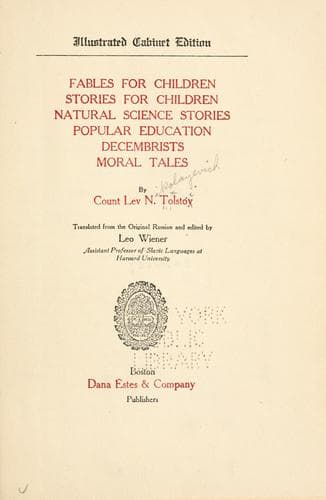
Fables for Children, Stories for Children, Natural Science Stories, Popular Education, Decembrists, Moral TalesTolstoy, Leo, graf
General
Fables for Children, Stories for Children, Natural Science Stories, Popular Education, Decembrists, Moral Tales
Tolstoy, Leo, graf
Russian literature -- Translations into English
In matters of the petty villages, forming one-half of the population,
the ministerial department acts most decisively. It says: "We provide
schools where there is a building and where the peasants of the township
have collected enough money to support a teacher at two hundred roubles.
We will contribute from the County Council what is wanting, and the
school is entered on the lists." The villages that are removed from the
school may send their children there, if they so wish. Of course, the
peasants do not take their children there, because it is too far, and
yet they pay. Thus, in the Yásenets township all pay for three schools,
but only 450 souls in three villages make use of the school, though
there are in all three thousand souls; thus, only one-seventh of the
population makes use of the school, though all pay for it. In the
Chermóshen township there are nine hundred souls and there is a school
there, but only thirty pupils attend it, because all the villages of
that township are scattered. To nine hundred souls there ought to be
four hundred pupils. And yet, both in the Yásenets and the Chermóshen
townships the question of the distribution of schools is regarded as
satisfactorily solved.
In matters of the choice of a teacher, the masses are again guided by
quite different views from the County Council. In choosing a teacher,
the masses look upon him in their own way, and judge him accordingly. If
the teacher has been in the neighbourhood, and the masses know what the
results of his teaching are, they value him according to these results
as a good or as a bad teacher; but, in addition to the scholastic
qualities, the masses demand that the teacher shall be a man who stands
in close relations to the peasant, able to understand his life and to
speak Russian, and so they will always prefer a country to a city
teacher. In doing so, the masses have no bias and no antipathy toward
any class in particular: he may be a gentleman, official, burgher,
soldier, sexton, priest,--that makes no difference so long as he is a
simple man and a Russian. For this reason the peasants have no cause for
excluding clerical persons, as the County Councils do. The County
Councils select their teachers from among strangers, getting them from
the cities, while the masses look for them among themselves. But the
chief difference in this respect between the view of the Communes and
that of the County Council consists in this: the County Council has only
one type,--the teacher who has attended pedagogical courses, who has
finished a course in a seminary or school, at two hundred roubles; but
with the masses, who do not exclude this teacher and appreciate him, if
he is good, there are gradations of all kinds of teachers. Besides, with
the majority of school councils there are definite favourite types of
teachers, for the most part such as are foreign to the masses and
antagonistic to them, and other types which the school councils
dislike.
Public-domain text, read in full here on John Shaqi.
Reviews
Reviews
No reviews yet
Be the first to share your thoughts on this work.
Elsewhere in the archive
Join the Discussion
Join the discussion
Sign in to leave a comment or review.
Sign InorCreate an account