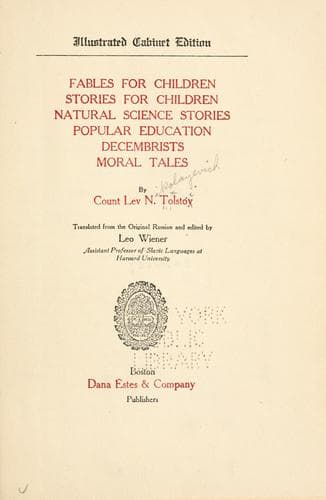
Fables for Children, Stories for Children, Natural Science Stories, Popular Education, Decembrists, Moral Tales — John Shaqi
Fables for Children, Stories for Children, Natural Science Stories, Popular Education, Decembrists, Moral TalesTolstoy, Leo, graf
General
Fables for Children, Stories for Children, Natural Science Stories, Popular Education, Decembrists, Moral Tales
Tolstoy, Leo, graf
Russian literature -- Translations into English
Suddenly I felt that I had slipped a little to one side on my saddle. I
wanted to straighten myself up, but was unable to do so. I wanted to
call out to the master to stop the horse, but I thought it would be a
disgrace if I did it, and so kept silence. The master was not looking at
me and Ruddy ran at a trot, and I slipped still more to one side. I
looked at the master and thought that he would help me, but he was still
talking with his friend, and without looking at me kept repeating:
"Well done, young gentleman!"
I was now altogether to one side, and was very much frightened. I
thought that I was lost; but I felt ashamed to cry. Ruddy shook me up
once more, and I slipped off entirely and fell to the ground. Then Ruddy
stopped, and the master looked at the horse and saw that I was not on
him. He said:
"I declare, my young gentleman has dropped off!" and walked over to me.
When I told him that I was not hurt, he laughed and said:
"A child's body is soft."
I felt like crying. I asked him to put me again on the horse, and I was
lifted on the horse. After that I did not fall down again.
Thus we rode twice a week in the riding-school, and I soon learned to
ride well, and was not afraid of anything.
THE WILLOW
During Easter week a peasant went out to see whether the ground was all
thawed out.
He went into the garden and touched the soil with a stick. The earth was
soft. The peasant went into the woods; here the catkins were already
swelling on the willows. The peasant thought:
"I will fence my garden with willows; they will grow up and will make a
good hedge!"
He took his axe, cut down a dozen willows, sharpened them at the end,
and stuck them in the ground.
All the willows sent up sprouts with leaves, and underground let out
just such sprouts for roots; and some of them took hold of the ground
and grew, and others did not hold well to the ground with their roots,
and died and fell down.
In the fall the peasant was glad at the sight of his willows: six of
them had taken root. The following spring the sheep killed two willows
by gnawing at them, and only two were left. Next spring the sheep
nibbled at these also. One of them was completely ruined, and the other
came to, took root, and grew to be a tree. In the spring the bees just
buzzed in the willow. In swarming time the swarms were often put out on
the willow, and the peasants brushed them in. The men and women
frequently ate and slept under the willow, and the children climbed on
it and broke off rods from it.
The peasant that had set out the willow was long dead, and still it
grew. His eldest son twice cut down its branches and used them for
fire-wood. The willow kept growing. They trimmed it all around, and cut
it down to a stump, but in the spring it again sent out twigs, thinner
ones than before, but twice as many as ever, as is the case with a
colt's forelock.
Public-domain text, read in full here on John Shaqi.
Reviews
Reviews
No reviews yet
Be the first to share your thoughts on this work.
Join the Discussion
Join the discussion
Sign in to leave a comment or review.
Sign InorCreate an account