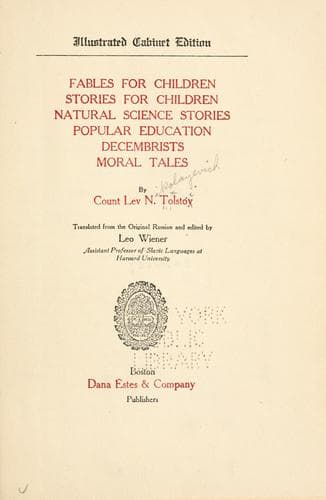
Fables for Children, Stories for Children, Natural Science Stories, Popular Education, Decembrists, Moral TalesTolstoy, Leo, graf
General
Fables for Children, Stories for Children, Natural Science Stories, Popular Education, Decembrists, Moral Tales
Tolstoy, Leo, graf
Russian literature -- Translations into English
Milton and Búlka made for him. Milton was near to the wolf, but was
afraid to take hold of him; and no matter how fast Búlka ran on his
short legs, he could not keep up with him. We ran as fast as we could
after the wolf, but both the wolf and the dogs disappeared from sight.
Only at the ditch, at the end of the village, did we hear a low barking
and whimpering, and saw the dust rise in the mist of the moon and the
dogs busy with the wolf. When we ran up to the ditch, the wolf was no
longer there, and both dogs returned to us with raised tails and angry
faces. Búlka snarled and pushed me with his head: evidently he wanted to
tell me something, but did not know how.
We examined the dogs, and found a small wound on Búlka's head. He had
evidently caught up with the wolf before he got to the ditch, but had
not had a chance to get hold of him, while the wolf snapped at him and
ran away. It was a small wound, so there was no danger.
We returned to the cabin, and sat down and talked about what had
happened. I was angry because the gun had missed fire, and thought of
how the wolf would have remained on the spot, if the gun had shot. My
friend wondered how the wolf could have crept into the yard. An old
Cossack said that there was nothing remarkable about it, because that
was not a wolf, but a witch who had charmed my gun. Thus we sat and kept
talking. Suddenly the dogs darted off, and we saw the same wolf in the
middle of the street; but this time he ran so fast when he heard our
shout that the dogs could not catch up with him.
After that the old Cossack was fully convinced that it was not a wolf,
but a witch; but I thought that it was a mad wolf, because I had never
seen or heard of such a thing as a wolf's coming back toward the people,
after it had been driven away.
In any case I poured some powder on Búlka's wound, and set it on fire.
The powder flashed up and burned out the sore spot.
I burned out the sore with powder, in order to burn away the poisonous
saliva, if it had not yet entered the blood. But if the saliva had
already entered the blood, I knew that the blood would carry it through
the whole body, and then it would not be possible to cure him.
WHAT HAPPENED TO BÚLKA IN PYATIGÓRSK
From the Cossack village I did not travel directly to Russia, but first
to Pyatigórsk, where I stayed two months. Milton I gave away to a
Cossack hunter, and Búlka I took along with me to Pyatigórsk.
Pyatigórsk [in English, Five-Mountains] is called so because it is
situated on Mount Besh-tau. And besh means in Tartar "five," and tau
"mountain." From this mountain flows a hot sulphur stream. It is as hot
as boiling water, and over the spot where the water flows from the
mountain there is always a steam as from a samovár.
Public-domain text, read in full here on John Shaqi.
Reviews
Reviews
No reviews yet
Be the first to share your thoughts on this work.
Join the Discussion
Join the discussion
Sign in to leave a comment or review.
Sign InorCreate an account